

Many researchers, including Elon professor of art history Evan Gatti, had to find out through an email that went to their junk mail that their federal grant — which many were relying on to support their dreams — had been revoked.
Gatti received her own email in her junk mail letting her know that the $250,000 grant she received from the National Endowment for the Humanities would be revoked effective April 2.
The NEH terminated over 1,000 grants, and the NEH sent termination notices to 65% of its employees, both of which came about a month after President Donald Trump forced out the head of the NEH. The NEH firings and cuts are in line with Trump’s executive order from Feb. 11, which directed the Department of Government Efficiency to eliminate “waste, bloat and insularity” in the federal government.
The NEH is not the only government department affected by cuts from DOGE — federal agencies such as the National Institutes of Health, the Department of Education and the Consumer Financial Protection Bureau have all seen mass layoffs.
Elon’s chapter of the American Association of University Professors hosted a Day of Action on April 17 with the goal of bringing attention to executive orders targeting education. Universities across the U.S. held similar events, and Elon was just one of five universities with programming in North Carolina. The AAUP’s mission is to give professors a voice and the ability to organize.
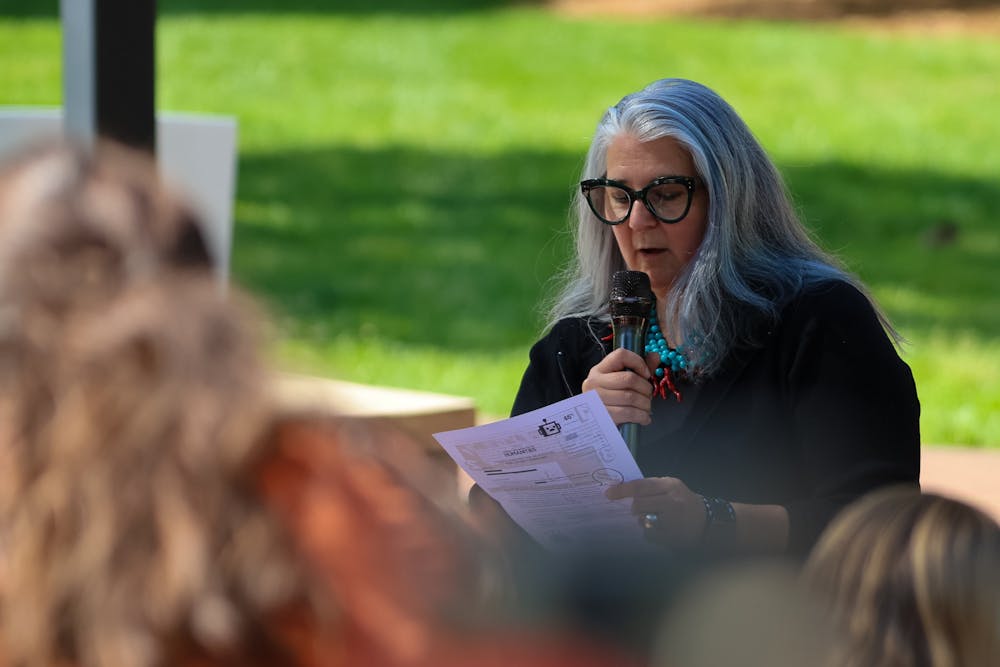
Elon’s Day of Action included 14 half-hour sessions on different topics, including one led by Gatti focused on attacks on NEH grants. Roughly 100 students, faculty and staff attended the session, with some professors bringing their classes for the lesson while some students and faculty came on their own.
Gatti’s research was a collaboration with six other researchers at different universities looking at restoring medieval manuscripts and using multispectral imaging to see writings and drawings that were previously lost, according to her research’s website. Gatti was not available for an interview.
Junior Ash Crouse, an art history major, said she has been in several classes that have talked about Gatti’s research, and it is something she has gained inspiration from for her own research.
Crouse is doing research on the connection between magic and disabilities and said that looking at old manuscripts that are about magic and its connection to medicine could help with her own research.
“It’s an amazing thing,” Crouse said. “It’s a newer technology, and I think we would be able to do a lot with that.”
The email from the NEH said this was effective as of April 2, meaning not only would they not be able to spend money and continue their research, but there were people who had already been doing work who would not be getting paid.
“There was money in the pipeline, lost money,” Gatti said in her AAUP presentation. “We didn’t just not get money — we lost money. People aren’t going to get paid.”
Loss of grant money has also affected local museums, including the Pauli Murray Center in Durham. The center, which officially opened in September 2024, is a renovated version of Murray’s childhood home in Durham. Murray was a civil rights lawyer and an activist for people of color and members of the LGBTQ+ communities.
Earlier this month, the Pauli Murray Center received notice that a $330,800 federal grant from 2024 was terminated. The termination notice said the grant is no longer consistent with the Institute for Museum and Library Services’ priorities and does not serve the interest of the U.S.
The grant was slated to make up close to 16% of the 2025 fiscal year and roughly 20% of its 2026 fiscal year budget. This funding went toward partnering with artists, faith leaders, educators and other members of the community to create new programming for the center, Angela Thorpe Mason, executive director of the Pauli Murray Center, said.
“Without access to the funding, we are no longer in a position to design, fabricate and install a new exhibition in Pauli Murray’s home, childhood home that was supposed to center their humanity, their community and their spirituality,” Thorpe Mason said. “Those are some of the broad programmatic impacts and ripple effects from an internal organizational capacity.”
Thorpe Mason said the intentional erasure of a figure such as Murray is highly concerning.
“I was really struck by the language in the termination notice … ‘Our grant project no longer serves the interests of the United States,’” Thorpe Mason said. “To me, that comment is infuriating when you consider the very person who Pauli Murray was. They saw so much promise in America that they literally dedicated their life to shaping an America where everyone could live whole, free and unoppressed, equitable lives, regardless of race, class, sexuality or gender. And to me, there’s nothing more American than that.”
Down the line, loss of federal grant money could impact what people feel are important fields, such as civil rights history and art history, sophomore Justin Huemmer said. Huemmer is an art history major and said this field is already something many people don’t view as important. According to Elon’s spring registrar’s report, there are 20 students majoring in art history.
“It is very common for people to kind of look at our classes, look at our major and say it’s kind of like a useless major, and it’s dehumanizing at first,” Huemmer said. “But another thing is that art history in general is very underappreciated.”
Huemmer said as someone looking to go into building design and architecture, it is concerning not to know what careers will be funded in the future.
“It’s a direction that I’m really scared about,” Huemmer said. “People are starting to get their federal funding removed because somebody doesn’t like what they’re doing or doesn’t see it as important. It really raises an ethical question of, ‘What is important? What should we focus on and why should we focus on it?’”
As of right now, Crouse said Gatti has tried to reach out to NEH but has not gotten any response. Crouse said with Gatti’s research, and with her own research down the line, she doesn’t know yet what the future will look like.
“It was, like, a huge ‘Oh my gosh,’ situation. I can’t believe this is real. Next steps, really, is just waiting to see what happens,” Crouse said. “It is truly just a waiting and seeing type of situation.”