

Elon’s Haggard Avenue corridor project submitted its plan in hopes of federal grant funding this week. The project is the result of years of community feedback and would require an estimated $7.6 million. This move coincides with a government vocalization for cutbacks and a now-rescinded memorandum freezing all federal aid.
The corridor plan was approved by the town council on Jan. 14. The Haggard Avenue corridor project proposes enhanced safety, increased visibility and looks to encourage multiple types of transportation. The plan places an emphasis on connectivity and safety with pedestrian and bicycle routes. The town applied for the U.S. Department of Transportation RAISE Grant, a large federal grant that serves as an all-purpose transportation enhancer.
The corridor project faced uncertainty on Monday from a national memorandum freezing all federal grant funding. The memo was shortly rescinded two days later.
The grant-freezing memorandum issued on Monday is one of many early acts of the Trump administration to restrict federal spending. The Trump administration formed the Department of Government Efficiency on Jan. 20, which exists to “cut wasteful expenditures, and restructure federal agencies,” according to a statement by President Donald Trump. Federal grants account for one-third of total state funding, according to a 2019 report from the Congressional Research Service.
Town Manager Rich Roedner said the federal aid freeze was a partial concern, but the project will move forward as usual following the rescindment.
Elon’s Department of Planning and Zoning gathered feedback for the Haggard Avenue corridor project after finalizing the Haggard Avenue corridor study in 2023. The study identified many of the solutions present in the project, including tackling the high rates of speed and lack of transportation options along Haggard Avenue.
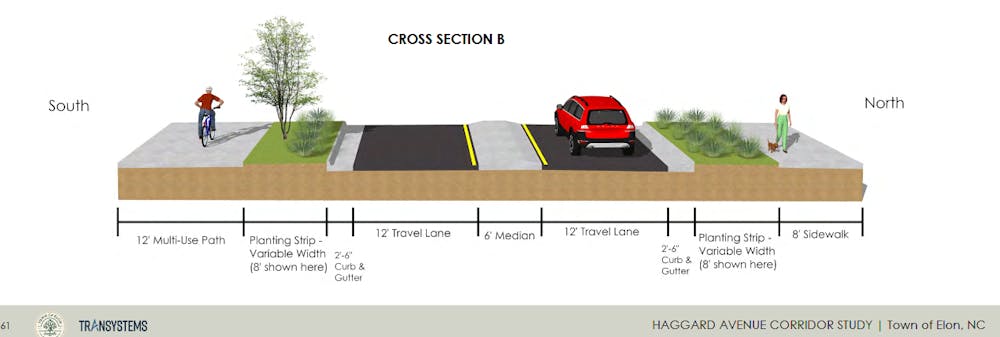
A visualization of the painting strips and sidewalks in the Haggard Avenue corridor plan. Visualization courtesy of The Elon Department of Planning and Zoning.
Roedner stressed the importance of introducing the project because of its benefits to pedestrian safety along Haggard Avenue after multiple pedestrian collision incidents. The Haggard Avenue corridor study shows a high rate of crash data along Haggard Avenue specifically. The study mentions nine bike crashes and 11 pedestrian crashes between 2007 and 2018. The plan emphasizes fewer contact points, which lead to a higher potential for crashes.
Early estimates project multiple years dedicated to updating Elon’s streets and $7.6 million in costs. Roedner said the project would be “one of the biggest installation projects in the town’s history.” Roedner said the project would increase pedestrian safety by lowering speeds and lessening the confusion over right-of-way. The project plans to include more space for cyclists to ride on the sidewalk, instead of in front of cars, something Elon Mayor Emily Sharpe said is important to residents.
“One of the number one things we hear from our residents is that they want more sidewalks,” Sharpe said. “The plans that we put into place look at those and plan for those, but it's all about funding.”
The project follows the lines drawn out by the Elon Land Development Ordinance of 2023, which stressed “bike parking within commercial and multi-use buildings, and requiring connected and widened sidewalks.”
Before the rescinded freeze in funding, Roedner expressed the difficulty of obtaining a federal grant.
“It’s like a shot in the dark. We are competing with everyone else in the state,” Roedner said.