

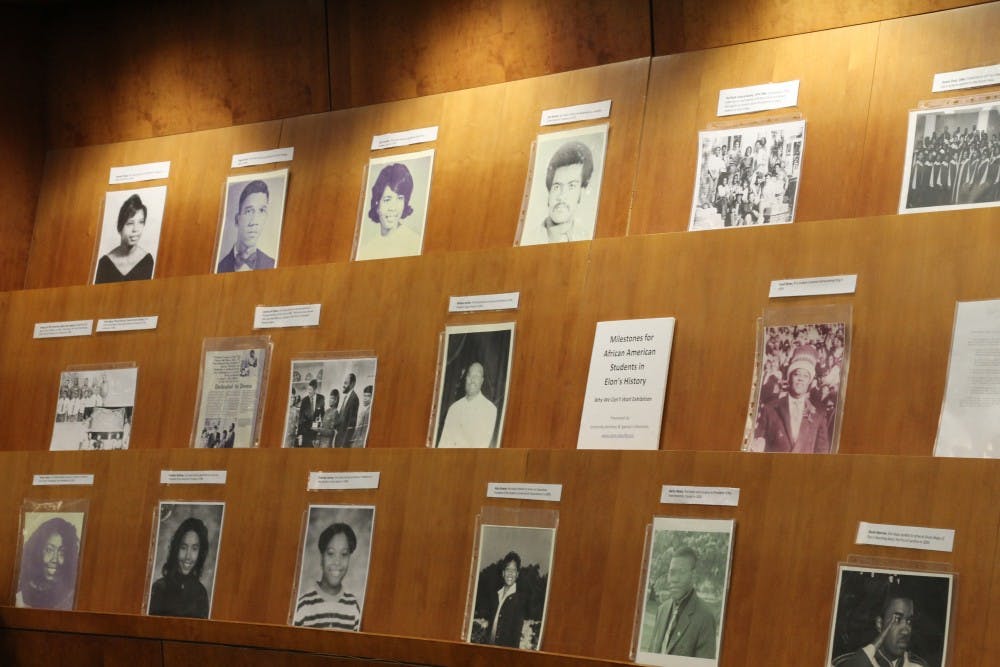
As a crucial part of Elon University’s progression in diversity and growth, the African-Americans who made history cannot be forgotten. Belk Library is commemorating many of these individuals through a display of various African-Americans who were some of the first of their race to attend Elon.
The display is called, “Milestones for African-American Students in Elon’s History,” and has been set up on the first floor of the library near Media Services and the information desks.
One student worker in the Belk Library sitting at the information desk has noticed several students stop by to examine the display, but not engage in a meaningful interaction.
“Usually I see students notice the board, but it’s not like they come up to us and start up a conversation about it,” said sophomore Jonathan Eves.
Belk Library Archives Librarian Shaunta Alvarez helped facilitate the compilation of photos for the display board that was initially made for the class of 2019 common reading book, “Why We Can’t Wait,” by Martin Luther King Jr.
Alvarez said she hopes the display will emphasize the need for students to be more open to meeting new people and building a more inclusive, diverse community.
“Every convocation, Dr. Lambert always encourages students to get to know people that they otherwise wouldn’t associate with,” Alvarez said. “I think that’s one of the key ways for folks to get to know one another and have deep meaningful conversations.”
Though the board is intended to facilitate a dialogue, several students have yet to see the display.
“I feel like since neither of us has seen it, maybe it should be moved to a more public spot,” said freshman Frances Keeler.
Alvarez explained how the display is just one of many resources the library offers in recognition of Black History Month.
Alvarez encourages students to read “From a Grove of Oaks: The Story of Elon History by George Troxler” and L’Tanya Richmond’s master’s thesis “Elon’s Black History: A Story to Be Told” to gain a deeper appreciation for Elon’s African-American history.
She also said the editorial column by student Ralph Moore, “Dear Beverly Axelrod,” in The Maroon and Gold’s 1968-1969 issues would be a worthwhile read.
Chrystal Carpenter, university archivist and assistant librarian, helped Alvarez with the display by overseeing the physical construct of the board. She recommended using the archives to gain additional information about Elon’s African-American history.
“I definitely think that archives are a way of looking at the past, but also a window into the future,” Carpenter said. “For anyone who is interested in what Elon is doing today, archives are a nice way to see how far we’ve come.”
Few African Americans were enrolled at Elon during the Civil Rights Movement, according to Alvarez. She said there was, and still is, a lack of minority representation on Elon’s campus.
“There weren’t that many black students here, and there wasn’t a lot of civil rights activity here, but I’m sure it was being discussed in classes,” Alvarez said. “It just didn’t make it to the headlines of the newspaper because it wasn’t here,”
Carpenter and Alvarez suggested former president Earl Danieley would be a terrific primary source for Elon’s history since he was president as the Civil Rights Movement gained traction (1957-1973). Danieley was the president who admitted the first African-American student into Elon College, Glenda Phillips.
Carpenter and Alvarez encourage the entire Elon community to stop by the library display to learn more about the individuals who brought more diversity onto Elon’s campus. The display will be up until Saturday, Feb. 13. After Feb. 13, books relating to the theme of Black History Month will replace the pictures on display in the library.