

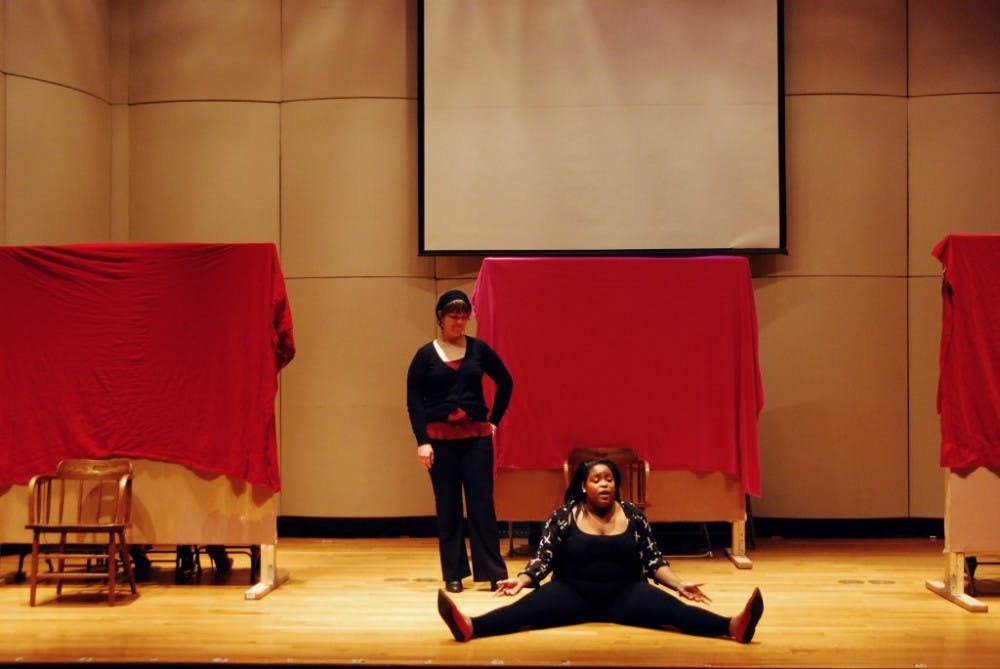
“The Vagina Monologues” has become a Valentine’s Day staple on Elon University’s campus, but the 2013 rendition was infused with an unabashed energy that heightened the performance. Sponsored by Women’s Gender Studies and Elon Feminists, the all-female cast performed for a full Yeager Recital Hall, which offered aisle seating to accommodate the overflow.
“The Vagina Monologues,” written by Eve Ensler and first performed in 1996, is a series of monologues surrounding women and the various conversations surrounding their vaginas. From a sex worker who loves to make women moan to an older woman scarred into ignoring her vagina until old age, the monologues cover every problem imaginable.
With this unusual topic, things can get uncomfortable. As the play mentions, it is not often women talk freely about vaginas, which is why this play relies heavily on its performers. In this case, they did not disappoint.
Every actress, in her own way, embraced and brought her character to life in an organic way. Some of the highlights included the actress whose vagina was “pissed off,” which brought an extended applause.
The audience also responded with an exceptionally positive reaction when another actress reclaimed the c-word, encouraging audience members to scream it out with her.
The show may have opened to nervous giggles, but by the end, the hall was ringing with laughter. In between, there were moments of shuddering, where sounds of discomfort or shock could be heard, but that was why the play was created.The performers knew to play off the audience, talking to them as they would to their best friend and pausing to revel in the laughter.
The overall sentiment of the audience was delight and praise. Sophomore Yasmine Arrington saw the show after hearing about it long ago from a teacher at her high school who had performed in it. Seeing it at Elon, she said, was far from a disappointment.
“Sex can be a taboo, but it was amazing to see the different perspectives from different countries and different ages,” Arrington said.
Women like Arrington were not the only audience members. Tino Monroe, a sophomore from Papua New Guinea, was one of the male audience members.
“I came because I found the idea striking,” Monroe said. “I sought it out to learn more.”
Both Arrington and Monroe said “The Vagina Monologues,” which they assumed would include anti-male sentiment, pleasantly surprised them. Arrington said she thought men could learn more about women from the show.
This year, the show ended with something more powerful than a single final monologue – the women showed a video that depicted women struggling with problems against their gender, such as rape and genital mutilation. The video was for One Billion Rising, an organization fighting for women equality and women’s rights. While the video elicited some unpleasant reactions from the audience, it was a powerful way to end a show about women.
“The Vagina Monologues” may not be for everyone. There are not many people who are comfortable talking about vaginas or listening to stories about vaginas. But one thing can be said – all who came out to “The Vagina Monologues” left with a smile on their face and a little more knowledge about women’s struggles.