

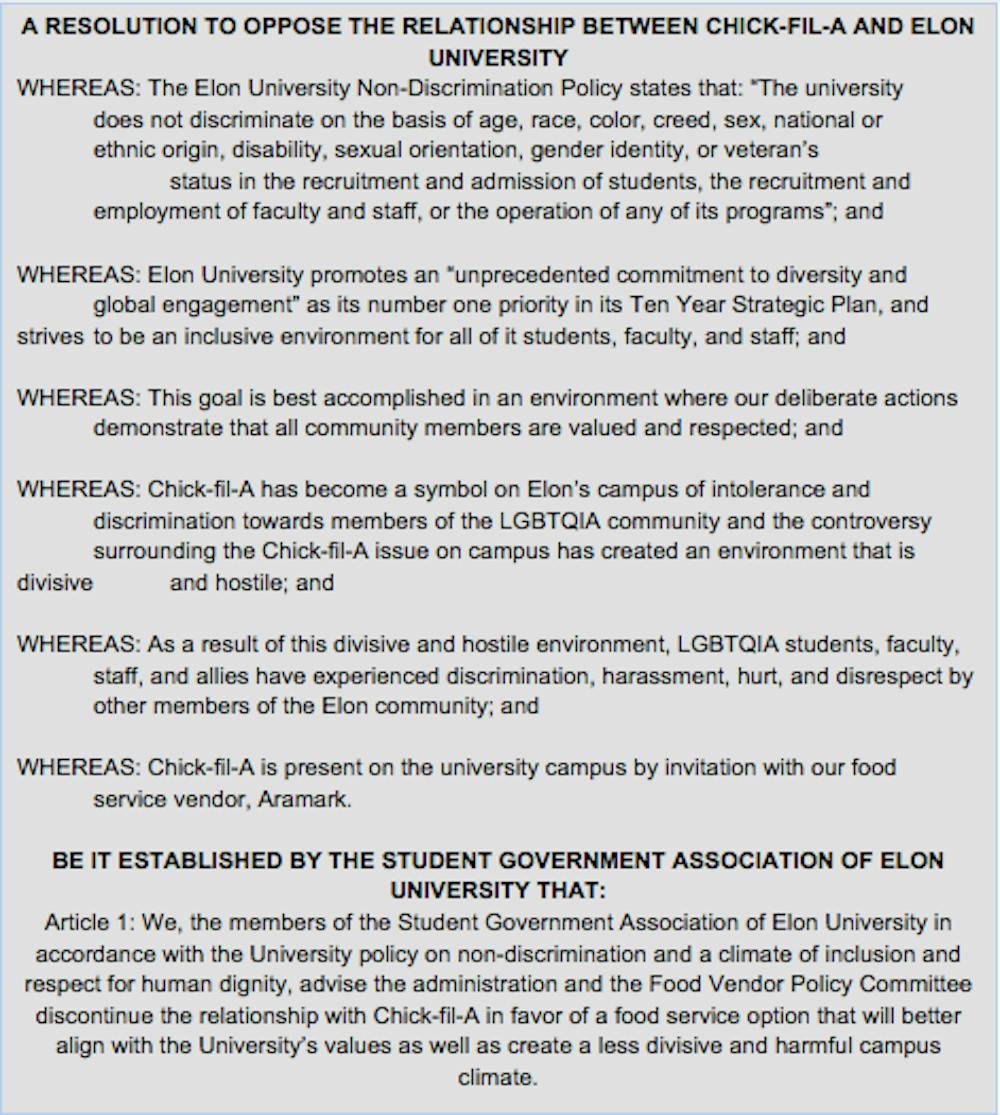
The revised legislation against Chick-fil-A’s presence on Elon University’s campus passed in a 30-8-2 vote by the Student Government Associa
tion Nov. 29. The resolution, authored by Spectrum, Elon’s queer-straight alliance, argues Chick-fil-A has become a symbol of hatred and discrimination on Elon’s campus and advises the university's administration to sever the school's relationship with the franchise in favor of a vendor that “aligns with the University’s values as well as creates a less divisive and harmful campus climate.”The argument posed by the resolution differs from the original legislation submitted in September, which opposed Chick-fil-A’s donations to anti-gay organizations through WinShape, its charitable arm, and called for its removal from campus. The passage and the subsequent veto of the bill generated considerably controversy in the Elon community, and Spectrum revised and resubmitted the legislation in response to the contentious campus climate.
SGA Executive President Darien Flower's power to veto a resolution, rather than a bill, is not specifically addressed in the SGA Constitution, and it is SGA Executive Vice President Connor O'Donnell's responsibility to interpret the language surrounding the issue. But rather than attempt to veto the legislation, Flowers said he will instead abstain from signing the document. If the resolution is not endorsed or vetoed by Flowers within 14 days of its passage, it will take effect.
"I, as Executive President, disagree with the decision my colleagues made," Flowers said. "However, I’m not choosing to invoke the negative process of vetoing the legislation. I will not sign it, because I don't support it, but I don’t think that going through the veto process again is beneficial for the campus or any of the parties involved."
Nine students, one faculty member and one staff member attended the SGA meeting to emphasize the issues addressed in the resolution and encourage the Senate members to support it. No supporters of Chick-fil-A’s presence on campus addressed the Senate in the open forum.
“Regardless of your thoughts about Chick-fil-A, it has become a symbol of discrimination on campus,” said Ross Wade, assistant director of career services in the School of Communications. “It makes me feel heartbroken and uneasy when I see the Chick-fil-A logo, and I know it makes other students and faculty feel the same way. If a few students are in pain, the entire campus suffers.”
Sophomore Josh Kaufman agreed.
“Look at the core of what this is really about,” he said. “All of this is really about human emotion. When my peers hurt and my friends hurt, I hurt, too. I really just want to know what is stopping some of you from using the pain of our peers to as a reason to take a stance.”
The passage of the resolution followed a heated debate over a proposed amendment to its wording. After some discussion, the Senate considered revising the resolution’s charge to affirm the LGBTQIA community at Elon, oppose discriminatory action by Elon community members and recommend the examination of the existing and future relationships between Elon and all of its third party vendors.
Some Senators felt the amendment altered the core of the legislation and detracted from its author’s original argument.
“By removing the Chick-fil-A from Article 1, you’re removing the issue from the legislation,” said sophomore Sarah Paille-Jansa. “Now it doesn’t say anything at all.”
But senior Patrick Brown argued the amendment was progressive.
“We’re taking a stance that says we want to examine all vendors,” he said. “That’s something that’s reasonable. I don’t see why we should single out vendors on a case-by-case basis.”
Others said the amendment promoted inclusivity.
“It doesn’t change the context in which the legislation was written,” said sophomore Vaughn Vreeland. “It changes it to a more egalitarian kind of resolution. It offers sentiments from both sides.”
But freshman Alex Bohannon said the amendment skirted the issue at hand.
“This issue here is Chick-fil-A, so to take it out of the legislation defeats the author’s purpose in writing it,” he said “People of the LGBTQIA community have been affected by Chick-fil-A, so they want us to address the issue of Chick-fil-A.”
The intense discussion, which lasted for over an hour, was disheartening to some.
“I’m really happy the bill passed, but the debate over the amendment was so frustrating,” said Emily Kane, an advocacy and education chair for Spectrum. “If we wanted to draft a legislation affirming ourselves, we would do it.”
Senior Jasmine Whaley agreed.
“I’m glad it was passed because it’s a very strongly worded affirmation of the LQBTQIA community at Elon,” she said. “But I am truly, truly upset at the amount of discussion and the points that were raised in the discussion about why it should not be passed, because it feels like a lot of senators were trying to take the easy way out by not addressing the issue, which is not necessarily Chick-fil-A, but Chick-fil-A’s discriminatory practices.”
But Flowers said he thought the Senate's discussion was productive and democratic.
"All of our colleagues did a good job explaining themselves and articulating their point of view," he said. "Democracy is a two way street. We have things we agree with and things we disagree with."
Flowers expressed disappointment in the behavior of the supporters of the legislation who observed the meeting. Several voiced their disagreement with the Senate during its discussion of the legislation.
"I was disheartened by some of the anecdotal and extraneous noise," he said. "That isn’t helpful. I would say any time anyone comes in and observes the Senate, they need to be respectful. Even though you might not agree with everything that is said, it’s a place of reverence, and it needs to be treated as such."
O'Donnell said he was similarly disappointed in some of the addresses made to the Senate prior to the vote.
"There were a couple of remarks that people would 'hate to resubmit the legislation' if the desired outcome wasn't met," he said. "I don’t think that should be a point of pressure for our senators. Resubmission should be qualitative, not quantitative. Legislation should only be resubmitted if there are prevalent aspects of it that need to be addressed that weren’t addressed in the last legislation."
Flowers agreed.
"While submitting legislation is great, I would caution against saying that unless you get the outcome you’re looking for, this will be discussed at length until you get the outcome you want," Flowers said. "It's reminiscent of the discord and gridlock we see in Washington."
But Kane said Spectrum probably wouldn't have resubmitted the legislation if it didn't pass in the Senate.
"They can walk with us or away from us," she said. "But we're going to keep walking."