

Alamance County is experiencing an especially dry summer, causing several towns throughout the county to issue severe drought warnings and implement Stage 1 water conservation efforts. Although rain in recent weeks has helped ease the harsh conditions, Burlington and town of Elon officials continue to call on residents to practice responsible water use.
As students at Elon University settle back on campus for the start of fall classes, the university’s office of sustainability is encouraging students to support the ongoing water conservation efforts.
“It’s such an important part of our daily lives,” said Kelly Harer, associate director of sustainability for education and outreach. “But until the water supply is threatened, you don’t really think about it.”
Currently, about 70% of Alamance County is in a moderate drought, while the rest is in a severe drought. The drought statewide has lasted for about 10 months.
Harer said educating students about water conservation across campus is an important part of her job, hosting several events throughout the year to highlight sustainability. She said anyone who cares about equity and equality should also care about water conservation and work toward creating sustainable everyday practices.
According to Harer, one of the largest sources of water consumption for the average Elon student is long showers. She said this is an easy way for students to reduce their water use.
“Pick your favorite three- or five-minute songs, and you should be able to do everything you need to do in the shower in that amount of time,” Harer said.
Harer also highlighted the low-flow systems installed throughout many campus buildings that aid in water conservation, specifically showerheads and faucets that use less water than typical fixtures.
She also pointed to one of Elon University’s biggest uses of water: landscaping. She said the university works to maintain the greenery on campus while incorporating sustainable practices.
Elon’s landscaping team uses an automatic irrigation system that works to conserve water for gardening and other landscaping needs.
“We are big advocates for water conservation here at Elon,” said Scott Stevens, director of landscaping and transportation.
According to Stevens, each “bed,” or designated planting area, requires about 1 inch of water per week during the summer months to remain healthy, and the campus is made up of thousands of beds.
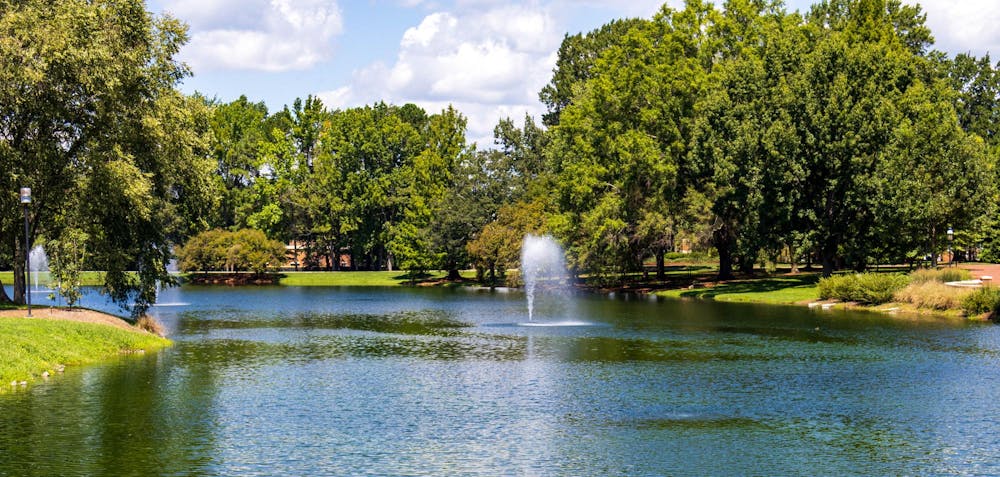
The university’s sprinkler system is also digitized to account for rainfall, preventing the overwatering or underwatering of plants across campus. Elon relies heavily on its own water features for landscaping needs. About 85% of the water used for sprinklers and flower maintenance comes from the university’s irrigation lakes: Lake Mary Nell, Lake Verona and South Campus Lake.
Stevens said he is aware of the drought conditions and has kept up with water restrictions across the state. But, because of Elon’s irrigation system and water supply, little has changed in the university’s watering practices after local towns announced Stage 1 water conservation measures.
While local reservoirs are experiencing low capacity levels, Elon’s irrigation lakes have remained well supplied throughout the dry months because of recaptured stormwater and parking lot runoff, according to Stevens.
Stevens said that he and his team have an unconventional method of measuring the water supply.
“If you look at the bricks in Lake Mary Nell, you can see the water levels,” Stevens said.
Stevens said that at the peak of the drought in June, about three bricks were visible along the lake’s edge. Now, the water level has risen to the point that only one brick is visible.
If drought conditions continue to worsen and begin to affect water supplies, Stevens said the landscaping team would prioritize watering athletic fields and flower beds.
Harer said that although nothing is enforced with current drought conditions, she recommends that community members be mindful of their water and energy usage upon moving in.
“It’s the offices of sustainability’s job to make campus more sustainable operationally and to educate,” Harer says. “But it’s up to the students, staff and faculty to implement changes as they are able to.”