

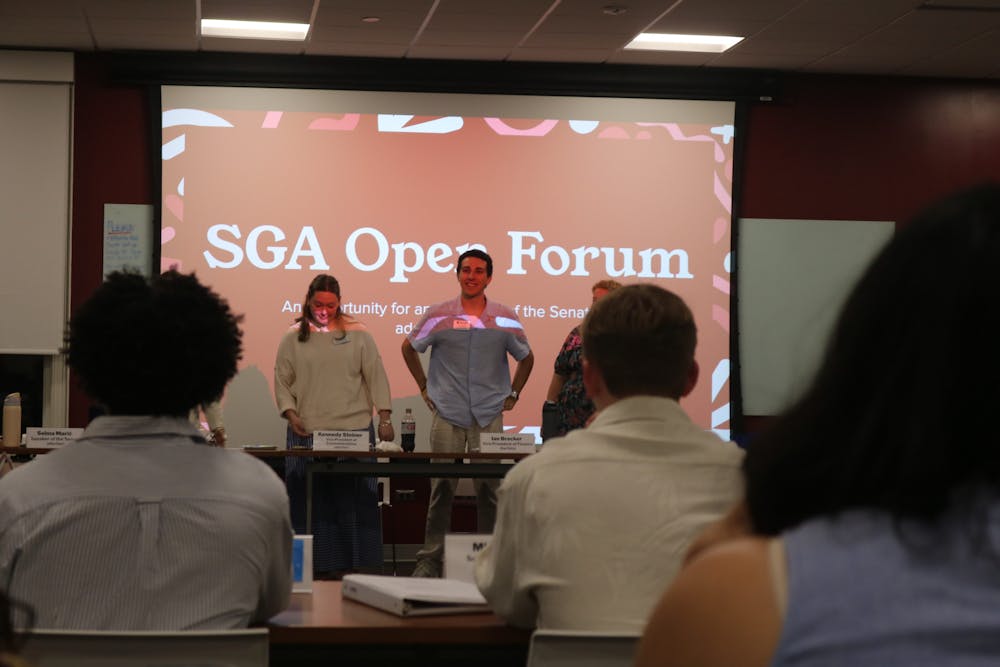
At Elon University’s Student Government Association, not every leadership role is decided by a student vote.
While students recently cast ballots for executive president and vice president, two executive positions, vice president of communications and vice president of finance, are filled through an internal application and interview process.
Final appointments will be announced at the first SGA business meeting of the new term on April 9, when newly elected senators will be sworn in and the new executive board will be introduced.
Members of SGA say this approach ensures candidates are chosen based on experience and not popularity.
“I think it’s important because they are so skill-based,” said Ian Brecker, current vice president of finance. “You don’t want to be based off of just who the person is. You want it to be based off of what experience they have and if they would be a good fit for the role, like any kind of job.”
Selma Marić, current Speaker of the Senate, said the process begins with an application submitted through PhoenixConnect.
“It’s very similar to a job application,” Marić said. “Candidates are asked about their experience, whether that’s in communications, finance or working within certain processes.”
After applications close, selected candidates move on to interviews held the week following spring break. Those interviews are conducted by a mix of current executive members, advisors and the incoming student body president, who ultimately makes the final decision.
Marić said the difference between elected and appointed roles comes down to what the work is.
“President and vice president are leadership-based and outward-facing,” she said. “But communications and finance are more inward-facing roles. They deal with internal operations and require specific, tangible skill sets.”
The vice president of communications is responsible for managing SGA’s messaging, including social media, website updates and promotional materials.
“You have to be creative and strategic,” current vice president of communications Kennedy Steiner said. “If you’re not presenting information in a way that’s engaging, people just won't see it.”
The vice president of finance works closely with student organizations to manage funding and budget requests.
“Communication is the number one skill,” Brecker said. “You’re working with a wide range of organizations so you have to be open-minded and able to explain decisions clearly.”
Both roles also collaborate closely with each other and the rest of the executive board.
Brecker said communications supports finance by promoting funding deadlines and updates, while finance relies on clear messaging from communications.
Marić said that although the process removes these roles from the student ballot, the student body remains at the forefront of minds when making decisions.
“The student body president is elected by the students, so there's a level of trust there,” Marić said. “When they’re interviewing candidates, they should be thinking about what the student body would want and what perspectives are missing from the executive board.”
The shift to an application-based system is recent. In previous years, all executive positions were elected.
Marić said the transition has strengthened the organization by bringing in candidates with more specialized experience.
“Seeing that change was honestly really positive,” Marić said. “You’re getting people who already have relevant skills, whether that’s working with budgets or having communications experience. It makes the board more effective.”