

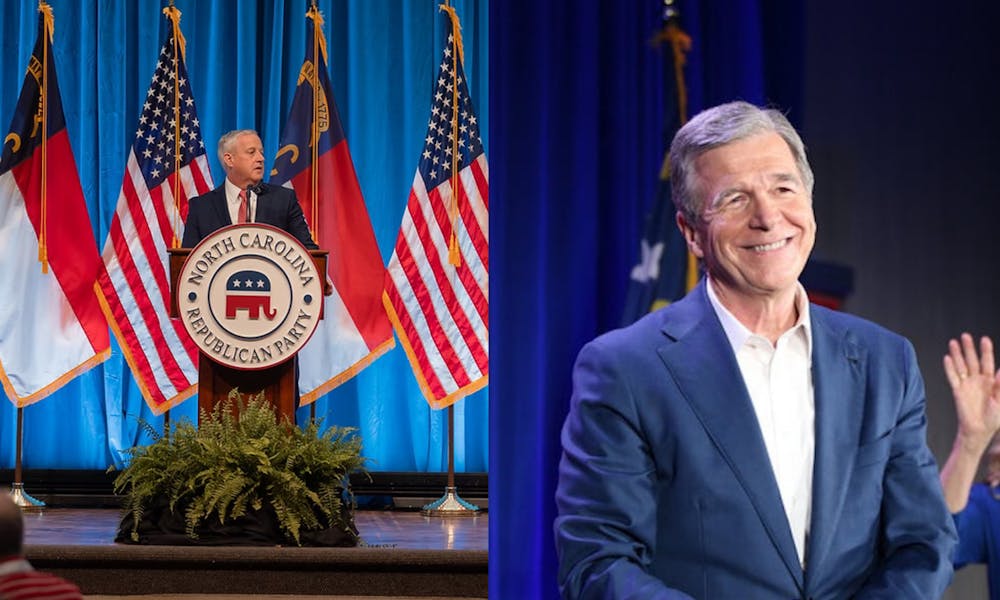
An Elon University Poll published April 2 found that Democratic candidate and former governor Roy Cooper holds a name recognition lead, with 70% of respondents saying they have heard about Cooper, with just 35% who have heard the same amount about his Republican opponent, Michael Whatley.
48% of registered voters viewed Cooper favorably compared to 34% who viewed him unfavorably. 25% of registered voters viewed Whatley favorably and 34% unfavorably with 41% holding a neutral opinion.
Director of the Elon Poll Jason Husser said this poll had several points of focus, including election fairness and administration, state approval ratings and policy issues.
Husser said that when creating this poll, they approached topics that they feel like North Carolina residents need to know about.
“It starts out with us asking, what are the major issues and topics that are going on in North Carolina government at any given moment, what are the things that people most need to know about,” Husser said. "And then designing a set of questions to try to measure those attitudes related to those issues.”
Husser said the process starts with a broad scan of what's happening in the state legislature and Congress and then crafting a set of questions. For this particular poll, they wanted the focus to be on both Iran and the general election.
“This particular poll, we focused on Iran because, for obvious reasons, it's a major military conflict there, but we also have a major election going on,” Husser said.
The poll surveyed 800 North Carolina adults. According to the poll, 38% of North Carolina voters say they expect a fair and accurate vote count nationwide in this year’s election, compared to 21% of voters and 41% not sure what to expect. This shows a decline from a poll conducted in August 2024 when nearly half said they trusted the accuracy of the vote and about a third were unsure.
According to the poll, 79% of Democrats, 56% of Republicans and 53% of Independents agreed that state governments should be responsible for election administration within their borders. North Carolinians have shown opposition to the idea of the federal government taking over election administration, particularly with the passage of the SAVE Act.
Voters currently show a preference for Democratic control of Congress. 40% percent of respondents favored Democratic control of both houses of Congress, compared to 35% who preferred Republican control.
Gov. Stein received a positive job approval rating with 43% approving and 27% disapproving. The North Carolina General Assembly earned a lower approval rating, with 21% approving of the legislature’s job performance and 37% disapproving.
68% of voters expressed concern in the federal cuts to health care. 47% of respondents gave the U.S. healthcare system a grade of “D” or “F,” while 30% give it a “C.”
Voters' stance on the economy remind the same compared to a September/October 2025 Elon University Poll, with 29% of respondents gave the state’s economic condition an “A” or “B” and 71% giving it a “C,” “D” or “F.”
Husser said polls like this one differ from other states’ polls due to North Carolina being competitive.
“North Carolina is a well-polled state relative to many states. It's a large state, and it's highly competitive, and so a lot of other survey research organizations have interest in knowing what's on the mind of North Carolina citizens and voters,” Husser said. “I’ve also found North Carolinians to be a little bit more critical of elected officials than you've seen in an average national survey, in part because we're a very contentious state.”