

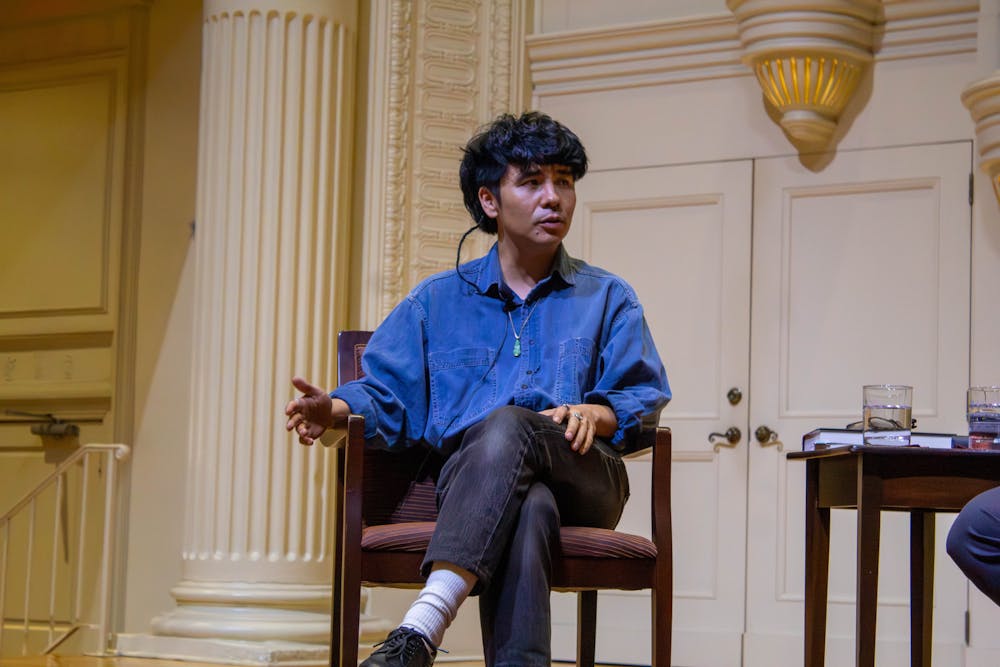
For poet, essayist and novelist Ocean Vuong, there is no right or wrong answer about what you should take away from his work.
“The beauty of writing is that everything is open to interpretation, and I'm never an author who can sit here and says to a reader, ‘you got it wrong,’” Vuong said.
Vuong was invited to Elon University by the Liberal Arts Forum, a student organization that plans and invites speakers to campus, to speak Nov. 17.
Former member of the Liberal Arts Forum, Emerson Garon, pitched for Vuong to come to Elon after being a long-time fan of his work and wanting to share his work.
“His work needs to be shared, he is just so inspirational,” Garon said. “We had the Gender and Sexuality LLC coming, First-Gen coming, all of these communities coming together to see this one person, it clearly is very influential to a lot of people.”
Vuong is a Vietnamese-American poet, essayist and novelist who was born in Ho Chi Minh City, Vietnam and later moved to Connecticut when he was two years old. Vuong has now published two novels, two poetry books and multiple other pieces of verse, prose and essays. His published work includes “The Emperor of Gladness”, which the Liberal Arts Forum read ahead of inviting Vuong to Elon.
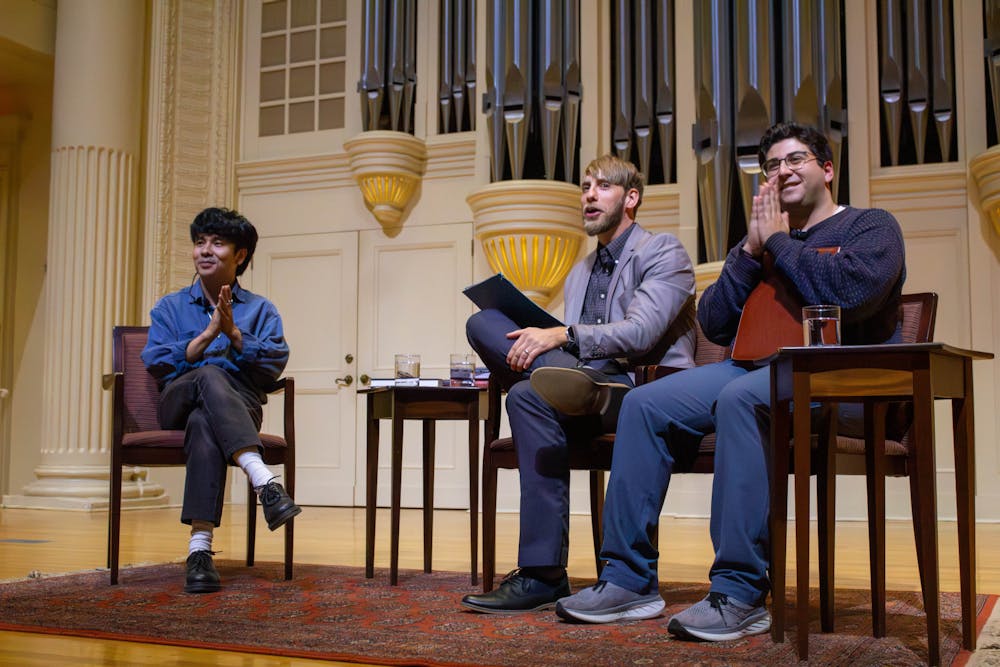
“This novel opens up on a seven, eight page description of a town and every writer workshop will tell you, ‘don’t do that,’” Vuong said. “When you write a book that becomes ‘successful’ I think you can earn certain stubborn maneuvers. And I really was interested in this maneuver because I kept exceedingly, you know, you get sent books’ debut or what have you and I kept seeing this trend wherein the novel seems to be auditioning for its adaptation.”
Vuong also said that he did not want this novel to revolve around escaping one's current situation.
“I wanted to write a book wherein people didn't escape, because I'm not interested in escaping and then being valuable because you escaped, but rather creating a world where you don't have to escape to have a dignified life, which is very uncommon to the American mythology,” Vuong said. “I knew that I did not want to fall into the trap of writing about working-class people in a way that made upper-middleclass people just feel good.”
Vuong later elaborated on the role of poets in today’s society, which he said have a near-impossible task.
“Every so often, you hear someone writing in a major magazine, ‘what's the point of poetry?’ It doesn't create revolution, it doesn't make anything happen,” Vuong said. “There's a kind of fetishization that the poet has to do the impossible, which is to do it all or to go away.”
Vuong also works as a professor at New York University’s masters of fine arts in creative writing program. He said he has seen the poets he teaches come into the classroom defeated because the world says they can’t be poets.
“I can see by their body language that they're already beaten down by the world because they've chosen to be poets,” Vuong said. “My students are using the same tools as the politicians and the corporate media and the corporations, pharmaceuticals, megacompanies. They're using the same thing, but they're doing it under the banner not for profit, votes or power. They're doing it under the banner of wonder, joy, linguistic curiosity, pleasure for the public, and that is too nebulous to be celebrated.”
The Liberal Arts Forum will continue to host speakers in the upcoming spring semester.