

Updated as of Nov. 13 at 10:001 a.m. to include video.
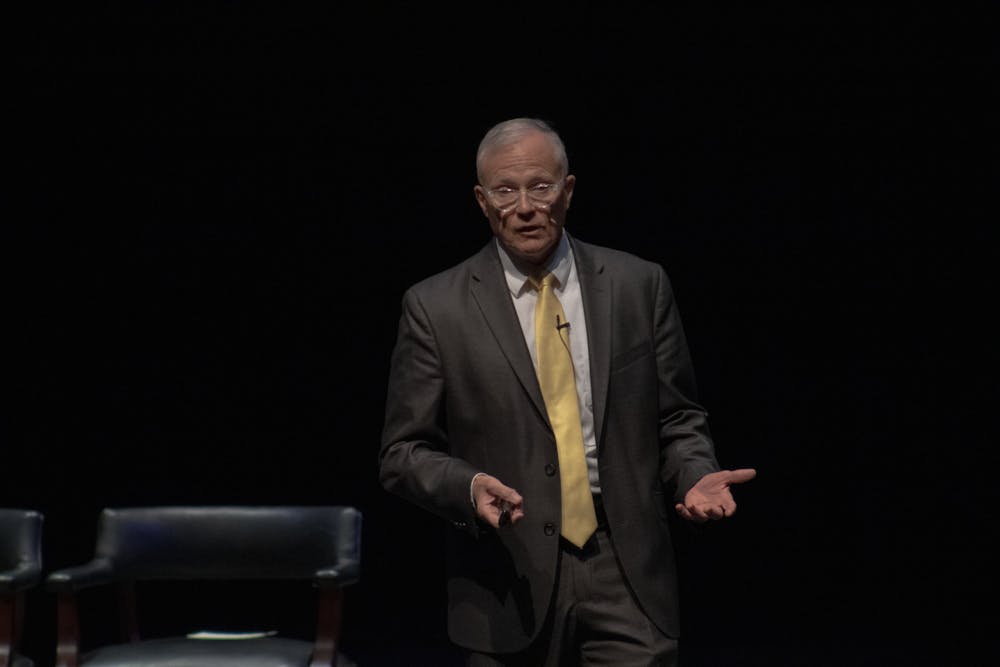
As part of Veteran’s Day programming Nov. 11, Elon University hosted retired Lieutenant General Robert P. Ashley, Jr. for the second annual Carol Ann Walker International Lectureship as a part of this year’s speaker series.
Ashley spent his career as an intelligence officer for the United States Army and served in the highest level of United States national security. His service includes tours in Iraq and Afghanistan. Ashley’s final assignment was as director of the Defense Intelligence Agency where he directly reported to the secretary of defense and the under secretary of defense for intelligence and security.
During Ashley’s speech in McCrary Theatre, he discussed his career and shared his views on the current global world from his work in Army Intelligence. Ashley shared messages of never knowing what circumstances the military will put you in when enlisting, the speed at which global issues get dealt with today, how the world’s view of the United States has changed and more.
After his speech, Ashley sat down with Elon News Network to discuss his career and views on veterans in today’s world.
This interview was edited for clarity.
Could you tell us about why you were asked to be here at Elon today?
I think if you look at the curriculum for the college — because it looks at geopolitical issues and international issues — specifically tied to the Carol Ann Walker lecture series. The fact that I spent my entire career as an intelligence officer, the last thing I did was as the Defense Intelligence Agency director, I'm the guy that's speaking to the chairman of the general chiefs, other senior leaders in Congress, about what's happening from the geopolitical standpoint, with our adversaries and threats globally. So I think I was a good fit, and it's been a pleasure.
What messages did you share with your audiences today?
A couple you know, it's Veterans Day. Some of the things that I want to do is make sure you recognize the veterans. And not only did I ask the veterans to stand — we serve as families — so after the veterans sat, I said, ‘If you are a sibling or a spouse of a veteran, please stand.’ So the message really about service.
We talked a little bit about the fact that it was the 11th hour, 11th day of the 11th month that the armistice was signed for World War One, ending the war to end all wars. Of course, only got into World War Two less than two decades later. So it was really about the context of service and the sacrifice those that have made before, and moving our way into the discussions of the complexities of what's really happening in the global world right now, and how the global world order that we've all enjoyed for the last eight years is being challenged greatly by a number of adversaries and competitors in ways that we've never seen the last eight years.
Could you take us through your career and how you decided to join the military in the first place, and how you got to where you are today?
I am a Air Force brat. What that means is my dad was in the Air Force, and then my brother was in the Air Force, and my dad was also — before I was born — was in the Army into the Korean War. And so service is in the family. I have an uncle that hit the beach at Normandy on my mother's side, and so I knew the inevitability that the military was in my future. I just wasn't sure the path it was going to take me there.
And interestingly enough, my sophomore year at App State, I'm walking across campus, and in the distance there's a guy in battle dress uniform — the fatigues we wore in the ’80s. And as we're walking toward each other, we're getting closer, I realize that it's a good friend from high school, a guy named Benny Duncan, and, ‘I had no idea you were here.’ So we go to the cafeteria, we sit down, we have a conversation. Then he goes, ‘You ought to go talk to Captain Fleur in the ROTC department.’ Well, I went to talk to Captain Fleur in the ROTC department. He gave me a bunch of tests. Next thing you know, I'm an ROTC and that's really how it all started.
I was fortunate. I finished pretty high in my class, and the thing that I wanted to be was an intel officer. So when I was commissioned in May 1984, I was commissioned as an army military intelligence officer, and I spent my entire career in the intel field, starting off as a second lieutenant in the 82nd Airborne, spent about a third of my career in special operations. Then, the last job I had, I ran the Defense Intelligence Agency in D.C., working for the chairman, the Secretary of Defense.
How many places have you been to? What was your favorite that you've enjoyed?
Lots of places. We did [Fort] Bragg a couple of times. We had a couple assignments in the Pentagon, in D.C., up in Pennsylvania, a number of places up and down on the East Coast. The only overseas assignment was Izmir, Turkey, which was a native assignment for a couple of years from ’97 to ’99 and then spread into that are several deployments in South America during the heavy counter narcotics years of the early ’90s. Then, after the global war on terrorism kicked off, after 9/11, I probably got a little over four and a half years between my deployed time in Iraq and Afghanistan.
As far as my favorite was probably my hardest job. I was the senior intelligence officer for central command down in Tampa, Florida, working for General Mattis. It was just incredibly rewarding. Learned a lot surrounded by just tremendous leaders and a great staff and a lot of great teammates, and I just learned a lot, grew a lot as a leader and as an intel professional during that job.
I’ve been fortunate that I have grown up and learned and been in the situation to work for a lot of people that are going to show up in the history books.
You worked as an Army Intelligence Officer. How did you get into working in intelligence, and what was that work like?
When you go through the ROTC program, they have branches — whether it's infantry branch, field, artillery, different things like that, or aviation. And military intelligence is one of the branches. So it's very competitive, and so if you finish near the top of your class, hopefully you get your first choice. Military intelligence was my first choice, and I had a pretty good GPA. So I got what I wanted to do and got to spend an entire lifetime working in the intel field.
What do you see as the biggest challenges facing veterans today?
I think there's an incredible sense of camaraderie. It's a very disciplined lifestyle. It is very team-centric, and I think you lose a lot of that, and sometimes your identity becomes who you are as a soldier, and you lose a little bit of the identity of who you are as an individual. As veterans transition out, some will struggle with that transition of what it means to be, ‘I was this soldier for so many years. Now I'm just me.’ You still have all that lineage, all that background. Should be very proud of all the things you did.
But even at the general officer level, and I had one of my senior leaders tell me, he goes, ‘About the 90-day mark, you're going to be in a little bit of a funk.’ Because I used to be the guy that did this and I was responsible for all this stuff, and now you may just be sitting on the couch or doing some consulting or whatever you've decided to pursue in retirement. It's just different, and so you have to work through that difference yourself.
But I think when you look at the things that you learned, the skills, the leadership, and all the things that you acquired over the course of military service, that is exactly what the civil world is looking for. Your ability to operate as a team, your ability to lead, your ability to take initiative, your self-discipline, that is all hugely valued by employers. The challenge is, ‘How do I translate what it was that I did in the military into civilian lexicon, where they have an appreciation for what I did?’ So I think that's some of the challenges, and the other thing is, we might be a little bit insular when we retire and not reach out to the civilian community as much.
You just touched on some of the challenges veterans are facing right now but what do you hope for them in future?
That they're comfortable, that there is life after uniform, and there's the next great adventures waiting for them and for their families. To embrace it with the same vigor that they did every job that they took on in uniform, because there's just so much more that they can contribute and so much more they can accomplish, not only wherever they're employed, but in their local communities.
The other thing is to really tell whatever your service is. Tell the Army story, tell the Navy story, tell the Air Force, the Marine, the Coast Guard, the Guardians. Tell your story, what it was like, because we really are about 1% of the population that served in the military. With each year, those numbers get smaller, and there are a few people that realize we're just like everybody else that lives in your neighborhood, we just chose a different profession.
Fiona McAllister contributed to the reporting of this story.