

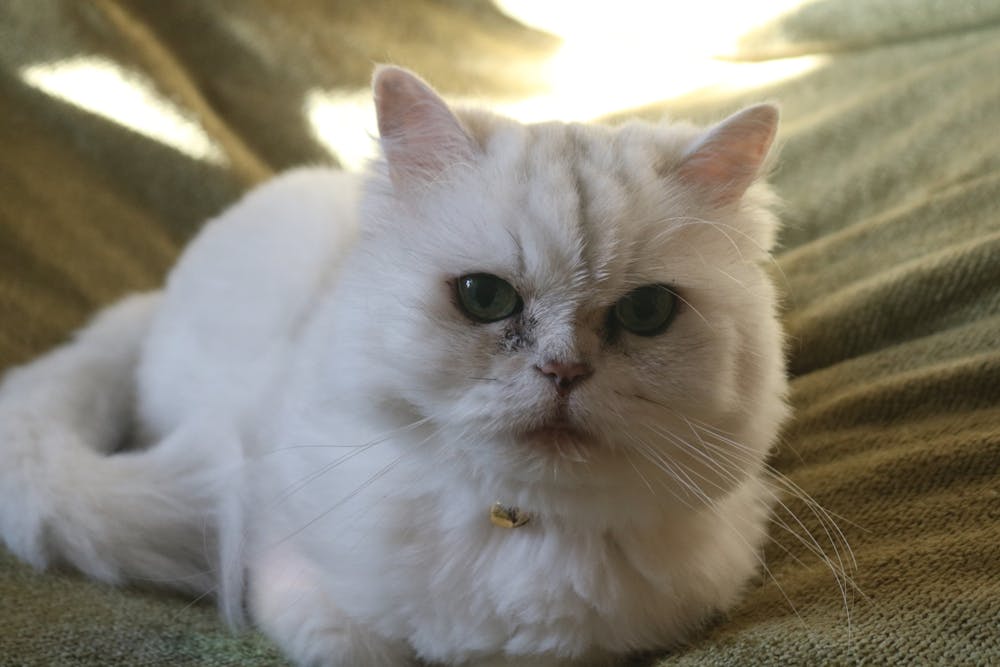
Abby Martin did not expect to bring Gracie, a 12-year-old British shorthair cat, to school with her for her sophomore year at Elon University. Martin’s mom flew five hours from Houston to meet her in North Carolina with Gracie under the seat in front of her.
Martin decided to register her family cat as an emotional support animal at Elon this year. She initially got a dog in 2020 to help with her anxiety, until she started college.
“When I started coming to school, I kind of started experiencing those issues again, and I really just thought it would be helpful to have an animal with me,” Martin said.
Martin said Gracie has been a huge help in dealing with stress and the workload of a college student.
“I feel like instinctually, whenever I’m stressed, I go down, pick up the cat, and just start petting her,” Martin said. “Just knowing there’s a presence there is just really reassuring.”
Gracie is not only sharing Martin’s space, but her roommate’s as well. But late night meows are not a deal-breaker according to Martin, who said Gracie is helpful for them both.
“I really think she’s become an ESA for the both of us,” Martin said. “Whenever she’s stressed, I’ll go, ‘Do you want to hug the cat?’ She’ll go, ‘Yeah, yeah I do.’”
Cats specifically are soothing for the human sense of touch, according to psychology professor Bilal Ghandour, an expert on anxiety disorders and self-harm behavior. He said the tactile feeling of interacting with cats provides a sense of calm and security.
“There’s some studies that have been done that the touching, specifically of cats, the fur of cats, reduces the level of stress in one’s body and cortisol levels because it just provides a calming impact on the entire nervous system,” Ghandour said.
In a study reported in the Journal of American College Health, a group of college students with ESAs were surveyed on the benefits and drawbacks of having their pet on campus. One participant said their physical PTSD symptoms were eased by the sound of their cat’s purring. Another said just their rats’ presence was helpful.
Ghandour said ESAs are beneficial to people who either struggle emotionally or in interactions with others because they will more or less always understand and comfort you without judgment. According to the Journal of American College Health, pets provide a sense of unconditional support, whereas humans can harbor a stigma surrounding mental health.
“They just don’t want to struggle on their own,” Ghandour said. “So we [clinicians] often write letters justifying why it’s essential to have a pet to help them as it allows to cope.”
ESA registration at Elon is considered on a rolling basis, with multiple deadlines throughout the academic year. Elon University has allowed ESAs on campus since 2012, with every request from dogs and cats to bearded dragons and fancy rats.
According to the Office of Academic Accommodations and Accessibility, formerly known as Disability Resources, to qualify for ESA approval, the student must submit a request and documentation from a licensed mental health professional justifying the ESA.
In a statement to Elon News Network, Alex Crabtree, an accommodation specialist at Elon, wrote, “It must clearly explain the impact(s) a student experiences with regard to their mental/emotional/psychological health and how having an ESA mitigates the impact(s) and barrier(s) they are experiencing.”
If approved by the ESA committee, the student needs to provide a photo of their animal, up-to-date vaccination records, completion of the ESA owner responsibility agreement and consent from roommates to share a living space.