

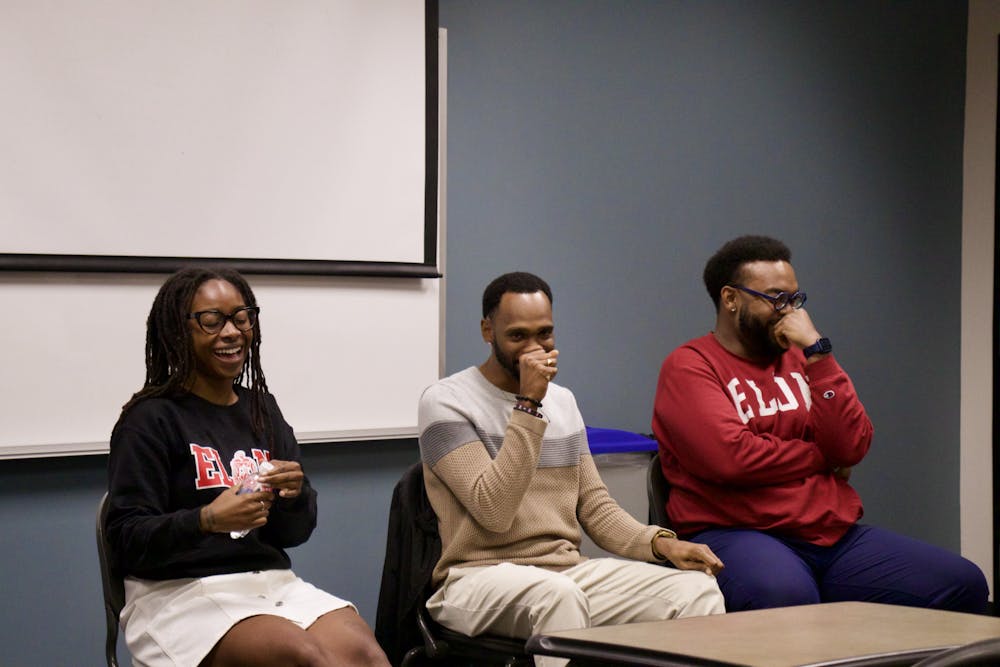
The Elon Black Alumni Network hosted its annual discussion panel on Oct. 23, welcoming students and alumni into the KOBC room, where they filled it with laughter, honesty, and reflection. The event opened with the icebreaker “Rose, Bud, Thorn,” which invited attendees to share moments of gratitude, growth and challenge.
Renaissance scholar and Elon sophomore Autumn Parish said her “bud” was that she was nearing the end of her research project — a requirement for all scholars — showing how this space gave current students a chance to share milestones and connect on a personal level.
Panelists Dyamond Howell ’19, assistant director of Alumni Engagement Initiatives; Alex Bohannon ’17, EBAN president; and Abdul-Malik Harrison ’21, assistant director of the Center for Race, Ethnicity and Diversity Education, led the discussion.
Together, they reflected on identity, community and the importance of bridging the gap between alumni and students.
When asked how their time at Elon helped shape their identities, Howell said her college experience taught her to merge confidence with consciousness.
“I was proud of being Black but not educated,” Howell said. “Now I’m a combination of both.”
Howell explained that growing up, she understood what it meant to be proud of her identity, but Elon gave her the language and knowledge to express it in new ways. She said for her, higher education strengthened — not replaced — her cultural awareness.
Bohannon shared that his decision to attend Elon was intentional because he had not been in a learning space where he could be seen as the minority.
“I purposely chose Elon to challenge myself to acclimatize to a new environment,” Bohannon said.
Coming from a predominantly Black and Hispanic public school, Bohannon said he wanted to experience a space that was different from his own community. “Bohannon said that while his decision was difficult at times, it helped him learn how to adapt while holding onto his identity.”
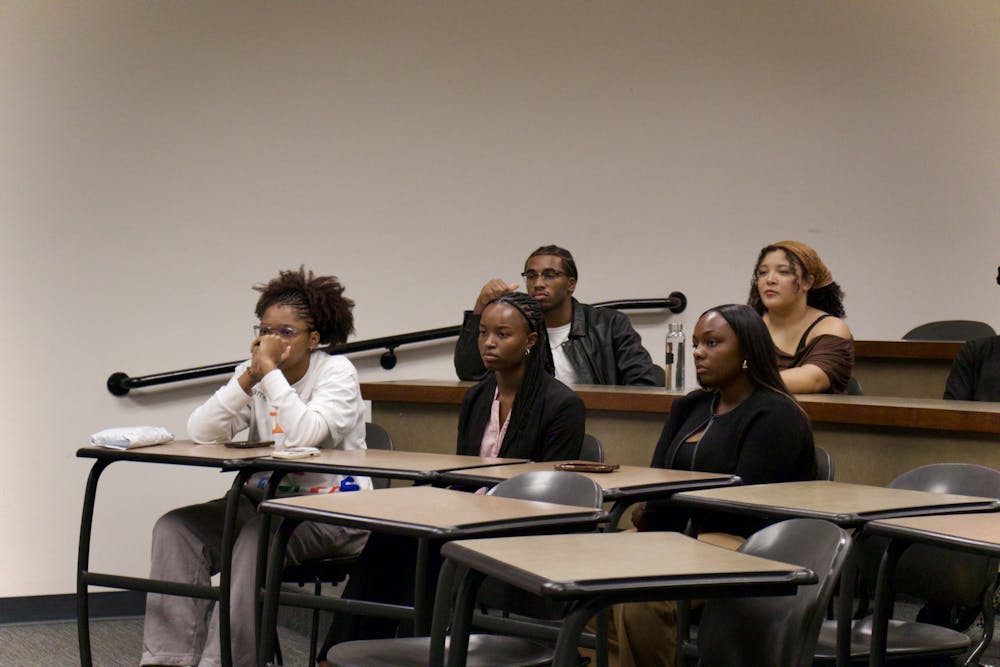
Renaissance scholars listen intently as panelist talk and encourage them during the Elon Black Alumni Network’s panel on Oct. 23 in the Ernest A. Koury Sr. Business Center.
As the conversation deepened, panelists discussed the meaning of community — a word often used on campus but experienced differently by each person.
Howell noted that the rise of technology has made forming genuine relationships harder.
“People don’t like in-person conversations anymore — it’s easier to text or email,” Howell said. “But you have to be intentional about the relationships and networking connections you build. It’s okay to feel uncomfortable trying something new.”
Her comment struck a chord with many students who nodded in agreement, recognizing how digital communication can sometimes replace authentic connection.
Each panelist offered a personal definition of what community means.
“A sense of belonging without obligation,” Bohannon said.
“Knowing who you can go to,” Howell added.
“Finding community is unique to everyone,” Harrison said.
Harrison elaborated, and said finding community is less about fitting in and more about understanding one’s role in the larger picture. He said belonging doesn’t require uniformity — it’s about shared purpose and mutual respect.
The panel also touched on the language used to describe identity. Howell challenged the audience to think carefully about how words like “minority” shape perception.
“You’ll never hear me say I am a minority — I’ve been minoritized,” Howell said. “Depending on your environment, that’s not something you are, it’s something that happens to you.”
Her comment highlighted the importance of context, environment and that identity isn’t static — instead, it’s often shaped by social structures and institutions. Harrison added that students at Elon often face a choice: to assimilate or to become more vocal and self-assured in their identity.
As the event came to a close, the panelists were asked what hopes they had for future Black students at Elon.
“My hope is for there to be a tighter connection between Black alumni and Black students,” Howell said. “I see EBAN as a strong presence by supporting, protecting and advancing Elon students.”
Howell explained that alumni can play a key role in mentoring and opening doors for current students — something she wants to see continue growing through EBAN’s initiatives.
Bohannon agreed, reminding the audience that alumni have power and responsibility.
“When you look at responsibility, look at the power,” Bohannon said. “As alumni, we’re in a position of privilege and power because we’ve graduated. I hope that we can build on that — the bridge of what students need from their alumni.”