

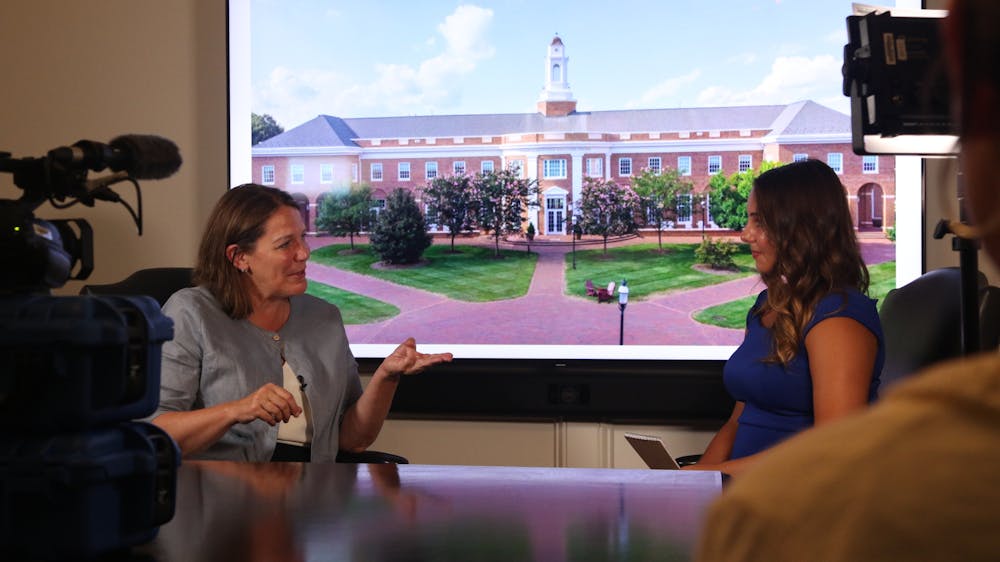
Elon University President Connie Book sat down with Elon News Network to discuss enrollment, health and wellness initiatives and campus expansions.
This interview was edited for clarity.
Why did Elon University not reach its enrollment goal for 2025-2026?
We set ambitious goals, both for the undergraduate and the graduate programs. We far surpassed our goal. We have a growth of 25% in graduate students this year on the undergraduate side, because of the changes that started to occur with the new administration, the new presidential administration, and changes in public university funding.
Elon had to make a decision, and that was should we admit more students who would fall below our normal admission standard and make up the difference? Or should we just sit and hold out and say, ‘Look, you know, this year will be a little smaller.’ It's not that dramatic, by the time you add our graduate students in. We made the decision just to hold and so we're bringing in a really qualified great class, a very Elon-like class and we don't think the competition is going to change.
We actually think this is kind of the new world of higher ed recruiting. So this summer, a group worked on updating some of the ways we approach our conversations with students who are trying to decide between a public institution like NC State. NC State was our number one competitor this year. Being able to offer our value proposition, the return on investment in attending Elon, and having such great outcomes from our graduates all across the country. Just to improve the way we talk about Elon, as people are considering a public choice or a private choice.
How is Elon University battling the 2025-2026 demographics cliff?
So we have been preparing — this is coming. We have seen this coming, and that's why you're seeing more students from Colorado, from the Minneapolis area and Texas. And you can see it when you drive around campus on the license plates. We actually have students from South Dakota here, and that is an intentional recruiting extension farther west than we were. We have added lots of admissions outreach toward the west, and that's all in response to the changing birth rates in the country.
We are also working very intentionally with international partners to grow international enrollment. We've been adding international students as well here as part of that strategy. One thing that's happening nationally is that we do have an upcoming birth rate decline of students headed to college, but generally fewer students are going to college. There is some debate out there about the return on investment, on paying for college, so we're doing everything we can to combat rhetoric around that. The reality is — I always say — if you can excel, go to college, because the data is clear, it will benefit you and your family's future for the rest of your life. There is a little bit of tension that even with fewer births and students going to college, you actually also have just people who are opting out of college.
What should students look forward to with the building of HealthEU and new initiatives within the program?
I'm really excited about HealthEU, because the building is symbolic. It's actually an integrated effort across our campus to put student well-being right at the center of an education. It will have very traditional things that you think of, like a workout space. It will also introduce students to a host of well-being initiatives that are part of the HealthEU initiative. Things like nutrition, outdoor education, financial literacy and how to build good social networks. These are the kinds of things that you want to make sure you have a toolkit in order to do.
What sparked the idea to add neuroscience and digital content management as majors and will there be more added?
We had so many requests for neuroscience as a major, we had it as a very popular minor, so we knew we needed the major
It's an interdisciplinary degree, so you have faculty from biology, exercise science, and chemistry all working together to build that major.
They also approved a new degree in the School of Communications, which captures the world of influence and social media, so trying to provide a good education for pathways into that kind of employment.
In May, the faculty also approved a master's degree in clinical mental health counseling. This degree will it's a two-year degree. It'll be offered here on the main campus and in Charlotte, beginning next fall. Many of our psychology students, but actually, public health and others go on to get a graduate degree in counseling. We're really excited to be able to offer that for our students.
How is the university adapting its strategic plan, Boldy Elon, to help students not just use artificial intelligence, but lead with it?
This is something at the heart of the Elon issue, right? It affects every major. It affects how we do business as an institution. It's definitely a tool. Elon has distinguished itself in higher education by writing the only undergraduate student guide to artificial intelligence, and in that, we just remind students the about the human integrity, that it's humans acting on it, so it's really important that we act on it, using it as a tool with a lot of integrity, and that those values should drive how we use it. Otherwise it could, it could be a dangerous tool.
Are there any plans to expand Elon University's Greek life on campus after adding Alpha Epsilon Phi just last semester?
We continue to have requests, which is really exciting. We've added Jewish, Latino and Asian fraternities and sororities. We take our lead from students and work to support them. Each of the organizations has different requirements, so when students come to us and they have a group interested in starting a new fraternity or sorority, we always work to support that — and sometimes that process can take two or three years — but we're here to help, and we want to respond to the student interest.
What is the goal that you're looking forward to meeting this year?
We’re at the halfway point of Boldly Elon, and so much has changed. We adopted that two weeks before the pandemic hit, and we've had just a series of so much change. We need to prepare all of our systems to be able to respond to those swings.
We're going to continue to be an undergraduate-focused institution, but I am excited about some of the new work we're doing in the graduate student space. Now they can think, ‘Here is something I want to do at Elon.’ Our work on our national campus, of bringing Elon into these urban settings — like D.C. and New York and now Charlotte, LA, like all of that — to me, is a really powerful way to extend the value of Elon University. I'm excited about that work too.
What is your biggest piece of advice for the class of 2029 or any transfer students coming to Elon?
Research shows the three most important things that should happen to you in college are, one is that you find a sense of purpose. The second thing is that you figure out how to pay for your life, and that sometimes your pay is connected to a sense of purpose, but not necessarily. Some people have jobs, and then their purpose-driven work is in the evening, and on the weekend, but purpose pays. And then the third thing is that you find who you're going to partner with in life.
The relationships you're forming in college are the people who will be with you in the highs and lows of the rest of your life. It's a good reminder those are the three essential things that are about to unfold for the class of 2029 and I want them to embrace that, but also know we're here to support them, then our community will be here to help.