

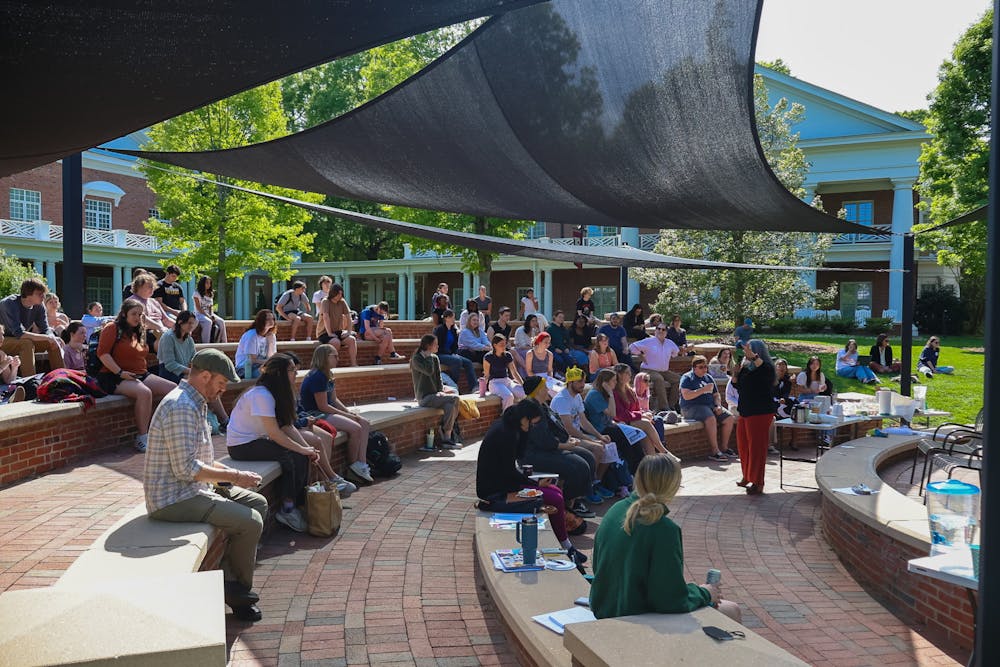
For nearly eight hours, Elon University professors across disciplines presented teach-in sessions at Belk Outdoor Theater on April 17 as a part of a nationwide Day of Action, organized by the American Association of University Professors.
A national AAUP event, the Day of Action aimed to bring attention to recent executive orders and actions targeting higher education. Universities across the U.S. chose to participate in a variety of ways, including discussion forums and AAUP membership drives.
Elon University’s chapter of AAUP chose to host public teach-in sessions to encourage attendees to stop by and learn without requiring prior knowledge of the topics, according to Elon’s AAUP Vice President, Kaye Usry.
Starting at 9:30 a.m., professors taught lessons every 30 minutes. With 14 sessions total, the sessions focused on topics such as immigration rights, Project 2025, campus activism and more. Despite the variety of each session, all returned to the same overarching theme of the impact of recent executive orders on higher education.
For Elon Law professor Eric Fink, he said the Trump administration's actions, and more specifically the Department of Government Efficiency, are not only impacting the efficacy of the judicial system, but also how he teaches law. In his session titled “Attacks on the Courts and Legal Profession,” Fink discussed the history of the ever-changing relationship between an executive branch and judicial system, not only in the U.S. but also in 1930s Germany.
Fink emphasized it’s unfair to compare the current state of the U.S. to that of Nazi Germany, however he pointed out similarities between the current administration’s actions and leaders of the Weimar Republic, which preceded Nazi rule in Germany.
With these similarities in mind, Fink pointed to the administration's use of executive orders and DOGE to cut funding and personnel for government agencies and programs — moves often made without input from the legislative or judicial branches.
“They're not simply cutting the money, and they're not simply cutting the personnel, but all of this is done with the goal of essentially unwinding their capacity to make rules and their capacity to enforce those rules through adjudication or through public prosecutions,” Fink said.
Fink’s concerns about government control were shared among audience members as well. When he opened up the session to questions and comments, one student asked for advice about how to trust the judicial system even after these cuts. Fink said he doesn’t believe the public should fully rely on the courts to keep the executive branch in check. Instead, he argued that growing distrust could serve as a catalyst for civic engagement and public organizing.
“People believe in the courts emotionally and ideologically," Fink said. "So to the extent that courts will continue to rule against the Trump administration, even if they can't actually enforce it, will embolden and help mobilize people."
While Fink used the space as a lecture forum, other professors used audience participation in their lessons.
Elon’s AAUP Treasurer and art history professor Kirstin Ringelberg’s “Museums are not Neutral” class attended their session which focused on one executive order targeting museums specifically. Ringelberg centered the discussion around an executive order titled “Restoring Truth And Sanity To American History” which restricts what Smithsonian museums such as the National Museum of African American History and Culture and the American Women’s History Museum can display. The American Women’s History Museum is currently in its planning stages and is expected to be built by 2030.
After receiving the executive order, the National Museum of African American History and Culture added a statement to it's website in response, which claims it will share the "unvarnished truth" of African American history.
Using their expertise in historiography, the study of how to teach and write history, Ringelberg explained that the ways in which history is taught in schools is typically decided by local governments and not the federal government. They said it's crucial for museums, like the National Museum of African American History and Culture, to not give in to pressure from the administration.
"A lot of the people who run the museums, the directors, the administrators, the Board of Trustees, will go ahead and censor themselves, and that's happened for sure in queer and trans history at the Smithsonian specifically," Ringelberg said. "But it's exciting to see that the National Museum of African American History and Culture is not engaging in that yet."
Some teach-in sessions also encouraged audience participation by distributing hand-outs for attendees, like “zines” during philosophy professor Maria Mejia’s session “Activism and Organizing on Campus.”
Throughout the day, students, staff and faculty filtered in and out, stopping by during their free time or even staying for the entire day. Elon’s AAUP had tables with information on how professors could join as well as pins and stickers promoting the organization.