

At age 4, Renée Fink’s parents loaded her onto a stranger’s bicycle with no explanation. She was taken to live with a Catholic family in Holland, and she never saw her parents again.
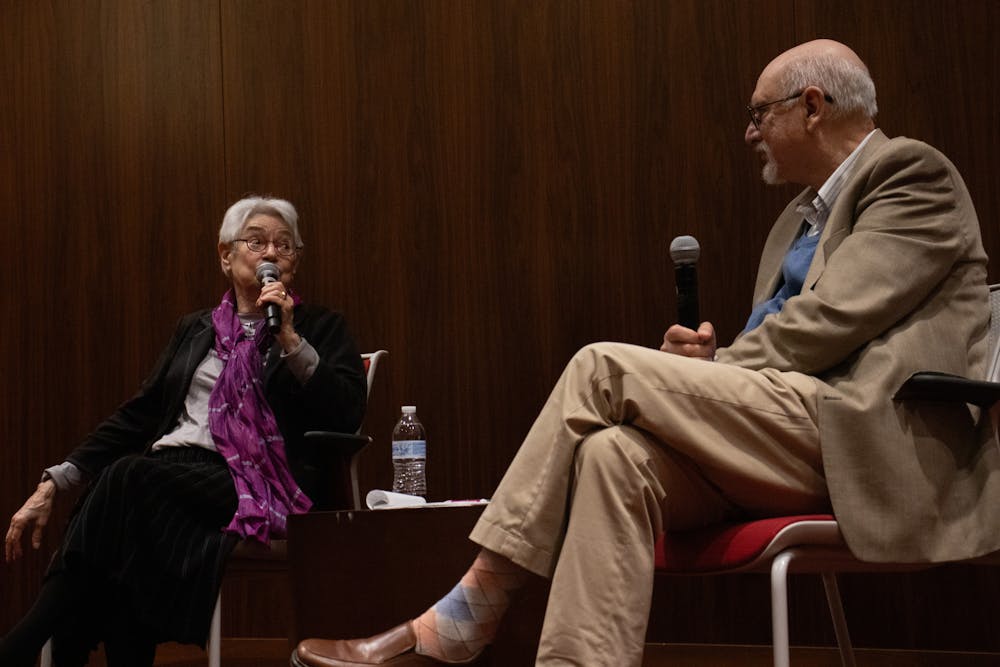
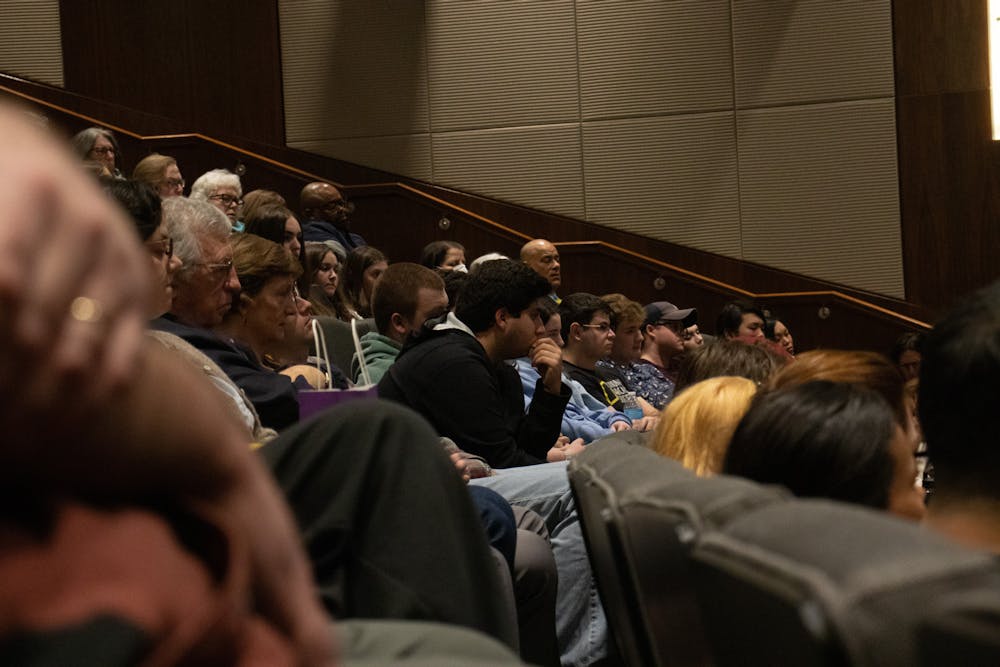
To a standing-room-only Turner Theatre crowd on Feb. 6, Fink shared her story as a childhood Holocaust survivor to an audience of Elon students, staff and community members. Her conversation with retired professor of journalism Richard Landesberg marked the latest event in an Elon tradition lasting more than eight years: inviting Holocaust survivors in commemoration of International Holocaust Remembrance Day. The event was hosted by the School of Communications, Truitt Center for Religious and Spiritual Life, Jewish Life and the Jewish Studies department.
“Everyone in my family was murdered, either in Auschwitz or in Sobibor,” Fink said. “My grandmother, one of her three children and I survived.”
The early years of Fink’s life were characterized by the courage she saw from the adults around her.
Born in 1937 to a Jewish family in the Netherlands, her parents sent her away, not knowing if they would never see her again but understanding it would increase her chances of survival.
In 1941, Fink moved in with the Van Den Brink family: two parents, five sons and three daughters, in a small house. She became the 11th family member and was given the name Rita. Her identity was changed to fit with her new family and remain hidden.
She said she is still thankful for the Van Den Brink family’s courage, knowing that if they were caught they would have been killed.
“What amazes me is that they didn’t know if I could be there a few weeks, a few months or a few years,” Fink said. “I learned the rosary, got a new name and became a devout Catholic.”
Though she did her best to blend in, there were features that made Fink stand out from the pale skin and blonde hair of the rest of the Van Den Brinks.
Fink said she was once stopped on the street by a woman who told her to wash her eyes because they were too dark. When German soldiers came to check the Van Den Brink home, the family would try to conceal Fink’s identity so she would fit in with the family. She recalled wearing a dunce cap during one visit and being buried under blankets under the guise of being sick during another.
Despite their biological differences, Fink said she still considers the Van Den Brinks her family. She re-established contact with them in her adulthood, with Mr. Van Den Brink signing off letters as “your war daddy.” Her honorary siblings visited her often, holding up the Chuppah at her daughter’s wedding and attending her childrens’ bar and bat mitzvahs.
“I was an only child, but I had five brothers and three sisters,” Fink said.
The young age at which she was sent away and the surroundings where she spent her formative years caused Fink to feel disconnected from her Jewish faith. In her early years, she said she didn’t even know she was Jewish.
“In those days, knowledge was so dangerous that you wouldn’t tell a 4-year-old these things,” Fink said.
It wasn’t until she went to college, years after moving to America, that she first went to Temple. She worked throughout her adult years to reconnect with her heritage, and now describes herself as “ethnically, fiercely Jewish.”
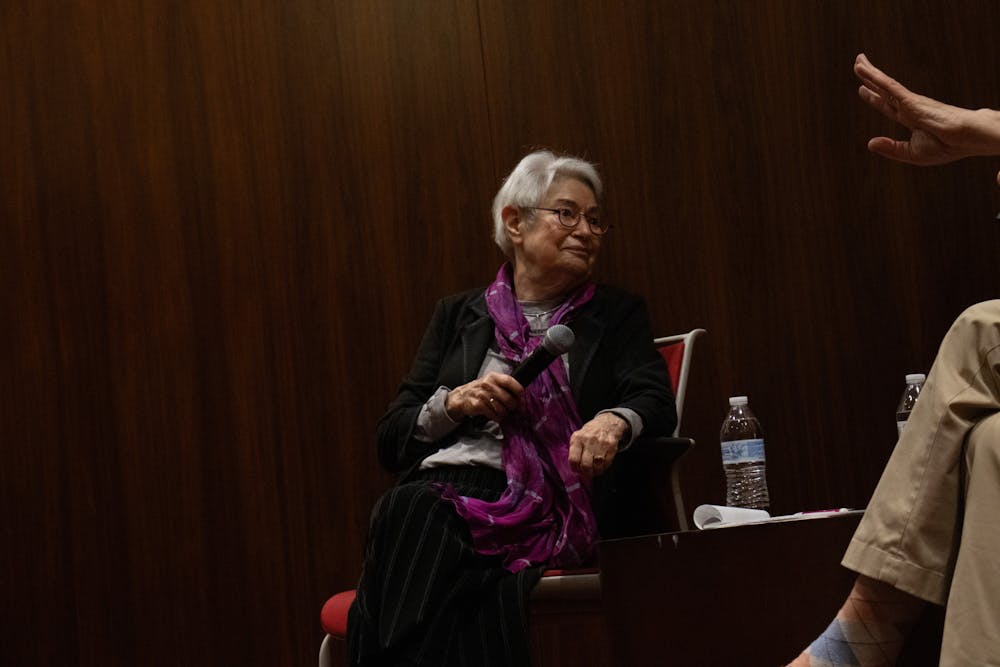
Initially, Fink did not often talk about her experiences, even to her own children. It wasn’t until 1991 when she attended a convention of childhood Holocaust survivors that she was inspired to speak on her experiences.
“It was our duty, our mission to speak so that it won’t be forgotten,” Fink said.
As part of what she feels to be her mission, Fink warned the audience about patterns she notices in the current U.S. government and across the world, encouraging young people to never forget the past and stand up for what is right.
Despite the hardships they have faced, Fink said she and other holocaust survivors don’t often cry about their experiences.
“If we start, we may never stop,” Fink said.