

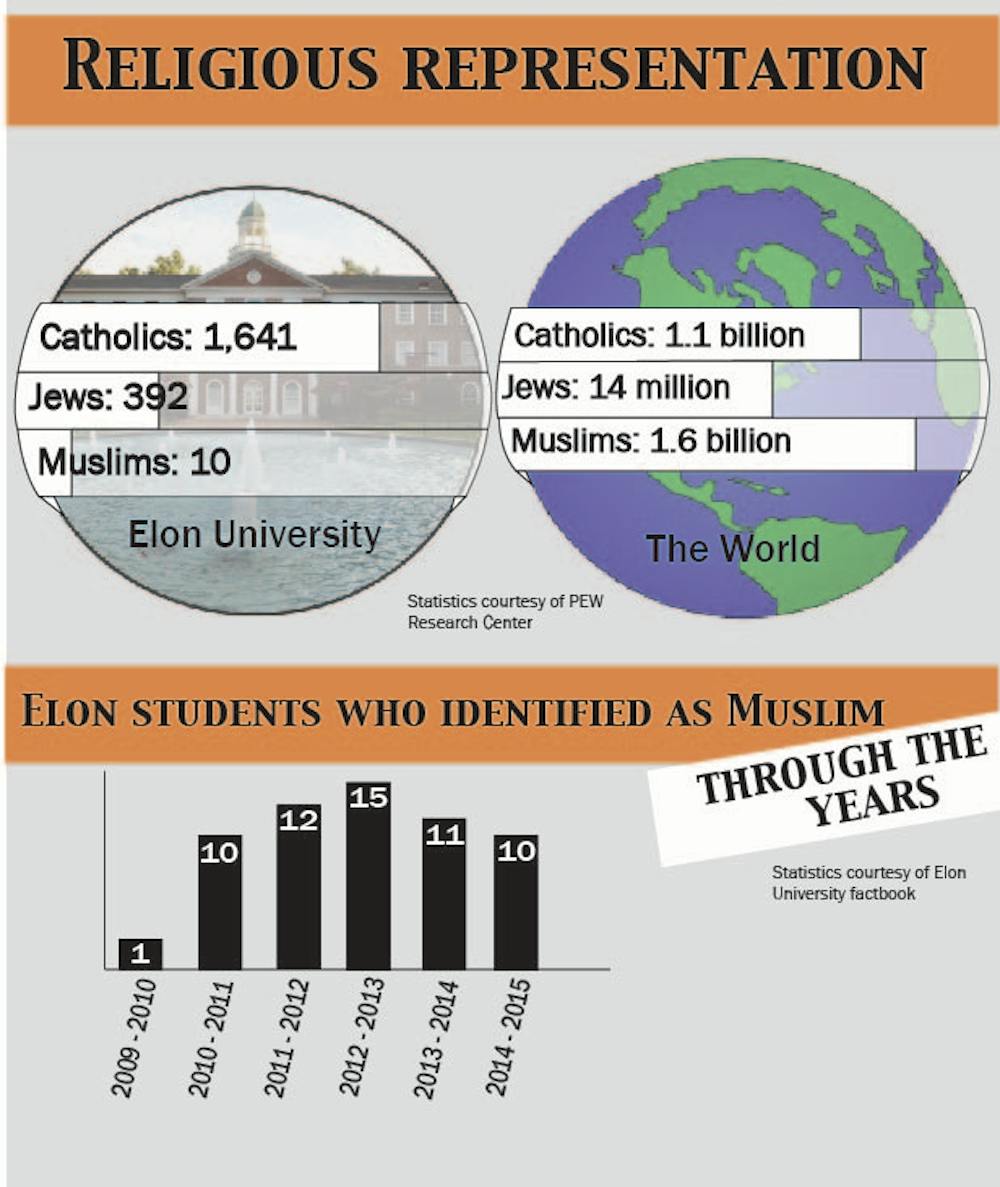
On any given day, junior Shahad Haswa can be found speaking with student groups, faculty or administrators on Islam, a faith she and just 1.7 percent of Elon University students practice.
According to the Elon Factbook, 10 students identified as Muslims for the 2014-2015 year, but Haswa is only aware of five students who are practicing and involved Muslims.
Elon students and administrators are working to address this difference in an effort towards improving diversity on campus.
As an executive intern to the office of the president, senior Carley Gaynes worked to advance the presence of Muslim students on campus.
Gaynes said she thinks an increase in support and resources would help grow the population.
“I think that there are a number of reasons why the Muslim student population isn’t as well represented as others, but largely, I think that it boils down to a need for support,” Gaynes said in an email. “In order for a community to thrive and succeed on their own, they must first receive the necessary support and resources from their surrounding community, and that is our job, as Elon students, faculty, staff, and community members who all proclaim our love, appreciation, and desire for diversity on campus.”

Filling the gap
Since arriving on campus her freshman year, Haswa has acted as an ambassador for the religion that is significantly underrepresented in comparison to Catholicism — more than 1,600 identifying students — and Judaism, a religion that has almost 400 identifying students.
“It’s not like I need a Muslim right next to me,” she said. “But we need to be able to recruit more people from the Muslim faith to represent on campus. It seems like every other faith is very much represented, very well funded and supported. But how can you have one of the biggest religions on Earth not represented? And that’s the gap we’re trying to fill.”
The junior marketing and entrepreneurship double major was born and raised in Amman, Jordan, with Islam in her blood.
After she had already looked at universities in the United Kingdom and Canada, a college counselor brought Elon’s liberal arts education to her attention.
The recipient of Elon’s King Hussein scholarship — an Elon scholarship given to Jordanian students — Haswa took the leap and chose Elon not only for the academics and opportunities but because of the opportunity to experience a different country.
“If I stayed home, I wouldn’t experience the abroad aspect of college,” she said.
She did not take into account the university’s religious life and culture, though.
“I know there are huge Muslim communities across the United States, but for me, I don’t need the community for me to practice,” she said. “If I believe what I believe and I have it with me, then that’s enough. My faith is just with me, wherever I go.”
Haswa said she was curious, though, to see what Muslim-based clubs, organizations and communities Elon had to offer.
But when Haswa got to Elon, she was surprised by the great disparity in Muslim representation compared to other religions.
“I don’t like to be critical, but the thought was more like, ‘OK, now what can we do about it?’” she said.
As a freshman, Haswa surrounded herself with a community of 10-15 older Muslim students who started the Muslim Student Association (MSA).
Haswa got involved with Elon’s MSA chapter by joining its executive board, to increase the group’s awareness and presence on campus.
When the majority of the MSA’s executive group and involved members graduated at the end of Haswa’s sophomore year, she said she was left with only a small handful of involved students who were practicing Islam.
“I first got to Elon and we had a little Muslim community, but by the end of my sophomore year they were gone,” Haswa said. “It was me, two other girls and one guy. They try to count the Muslim community on campus, including faculty and staff, but it’s almost nonexistent.”
Today, Haswa is the president of MSA and acts as a Muslim student representative to the Elon community.
“I’ve started representing Elon’s Muslim community,” Haswa said. “If someone needs a Muslim to talk, interview or recite verses from the Quran, I will. There are some students who don’t care, but for the ones who do, I’ll be the anchor.”
With a small Muslim population on campus, many Elon students are not aware of tenants of Islam. So when they do encounter people of the Muslim faith, they bring a laundry list of questions.
Some students attribute others’ inquisitive nature to the lack of Islamic presence on campus.
Sophomore Soad Ibrahim, a Muslim student from Kuwait, said she sometimes receives simple and even ignorant questions regarding her faith.
“It’s not students’ fault because they don’t know,” she said. “They just ask questions because they don’t know, but Elon can’t do anything about it because the population isn’t here.”
Resources available at Elon
As a part of Gaynes’ executive intern project to advance the presence of Muslims on campus, she created a website for Muslim Life at Elon, which is now live through the Truitt Center Website.
“One of the major issues that I (and others) noticed was that there was no one place that information on Muslim life at Elon could be accessed by the Elon community, or by prospective students.”
The Truitt Center for Religious and Spiritual Life provides prayer rugs and prayer rooms in the Numen Lumen pavilion for daily prayer.
Elon does not have a mosque. The closest mosque is the Pakistan Islamic Foundation in Gibsonville, minutes away. But the Truitt Center does hold events throughout the year to support the community.
Every year, the Truitt Center hosts an event that honors the Islamic holiday of Eid al-Adha, a feast holiday that celebrates Abraham’s willingness to sacrifice his son. Elon’s event incorporates food from different countries and cultures, as well as students who share their Eid al-Adha stories.
Looking to the future
Many students feel that a larger Muslim presence on campus is a necessary step in strengthening Elon’s commitment to diversity.
Sophomore Ben Lutz, who is concentrating in the Middle East with his International Studies major, said he hopes to see more diversity on Elon’s campus.
“I would like Elon to have more Muslim students to add to the richness of Elon’s community, as well as have better balanced discussions about current issues with all sides better reporesented,” Lutz said.
While support is needed to make the religious group’s presence on campus grow, Haswa understands that it will not happen overnight.
“Because we don’t get the attention and support we need, it’s hard for us to grow,” she said. “So right now, we’re just trying to stabilize it and be there whenever we can.”
Haswa believes breaking the stigma and stereotypes associated with Islam is a step in the right direction.
“When we talk about Islam we have to make sure we’re not just associating it with the Middle East,” Haswa said. “There are Muslims in Africa, Asia, Raleigh. They’re everywhere. It’s not like they’re just not attracting one ethnicity or country. It’s a whole nation.”