

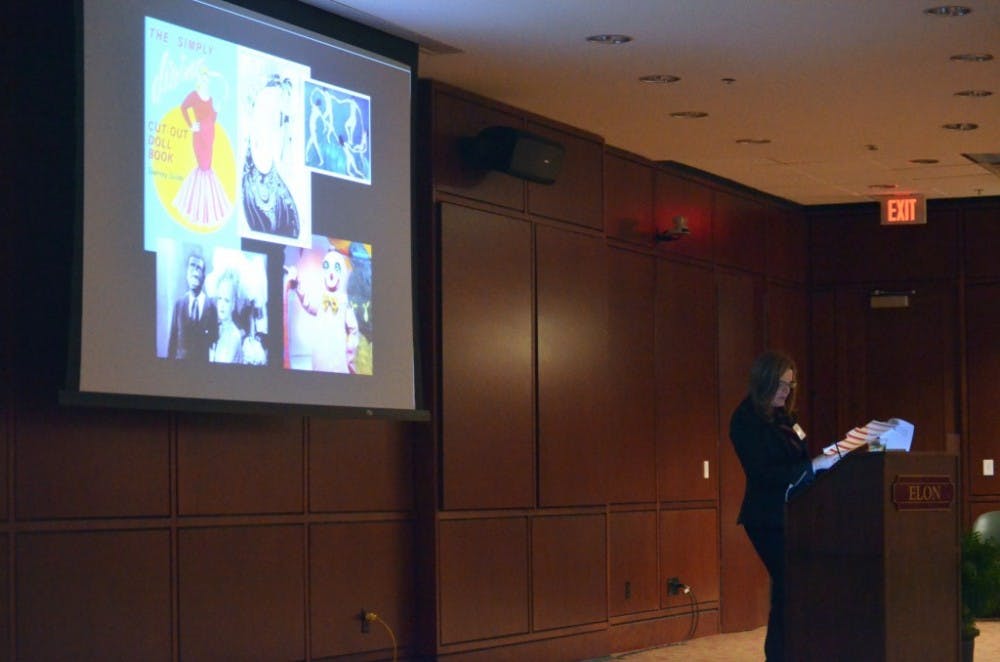
In honor of the art history department’s 10-year anniversary, discussions on transhistories of the visual echoed through the halls of Elon University’s Koury Business Center during a two-day symposium.
Between, Among, and Across: Transhistories of the Visual was the theme of the two-day on-campus conference Friday and Saturday.
Approximately 50 Elon students, faculty and staff members as well as visiting guests attended the event, which featured 17 lecturers and presentations.
Alumni of the department and nationally accredited and acclaimed scholars gathered to share their research and opinions.
Erin Day ’11 presented Friday on the topic of “The Corporeal and the Contemporaneous: Screen Dance and the Matter of Media.” She said she was pleased to see how the art history program made strides and hosted a symposium.
“A conference is so essential to discussion,” Day said. “It’s how scholarship happens.”
Melissa Spencer ’09 said it’s great Elon is doing something as big as a two-day symposium.
“It’s good to see people from outside of Elon [come and speak],” Spencer said. “Having an art history speaker is another key perspective for students and scholars.”
Dr. Jill H. Casid, professor of visual studies in the Department of Art History at the University of Wisconsin-Madison, presented the keynote address, “Art History on the Hyphen,” Friday evening.
Her presentation was based on the idea that the history of art is positioned on an altering and transitive hyphen.
Casid demonstrated how re-versings of a Roman imperial text’s metamorphic scenes across a range of media work relate to the transformative properties of hyphenation.
“I think it was fruitful to see [Casid] talk,” Day said. “It had a good overarching statement about the discourse of art theories.”
Kirstin Ringelberg, Elon professor of art history who co-organized the event, said the speech was a great example of a challenging art history talk.
“The ideas were complex and far from easy and within the talk was a challenge to art historians to rethink the way we do what we do — to be more directly engaged with the interconnections between and across our normal ‘tidy little boxes’ of categorization and method,” Ringelberg said.
Casid received her B.A. with honors from Princeton, her M.A. from the Courtauld Institute of Art at the University of London and her Ph.D. at Harvard. She went on to serve as the first director of the Center for Visual Cultures at the University of Wisconsin-Madison. Her academic background impressed many of the event’s attendees.
“Dr. Casid is one of the early developers of the study of visual culture in our country — she’s a major international figure in that regard — so it was also exciting to have someone on our campus with that stature supporting our curriculum’s and discipline’s self-critical questioning,” Ringelberg said.
An art history minor was formally introduced to Elon in the 2004-2005 academic catalog. In 2007, an art history independent major graduated, and the first official art history degree was received in 2008.
In the past 10 years, the department has graduated 40 majors and more than 60 minors.
The department has also dramatically changed the curriculum from teaching primarily Western-focused surveys to teaching almost exclusively discussion-based classes and seminars that look at more than just one continent.
Ringelberg said she sees the student involvement in the program as a key to success.
“We also really enjoy our program — we love our students, we all get along really well and we think art history is both complex and exciting — so we have a good energy that I think students really do respond to,” she said.
Ringelberg added that a demand to grow will not decrease the rigor of the department’s coursework.
“We refuse to lower our standards in terms of the quality of our classes and undergraduate research projects to make ourselves more popular, however, and we know that means we might not always satisfy the drive for greater numbers,” she said. “That’s a chance we’re willing to take, but we’re of course also looking at ways to grow.”