

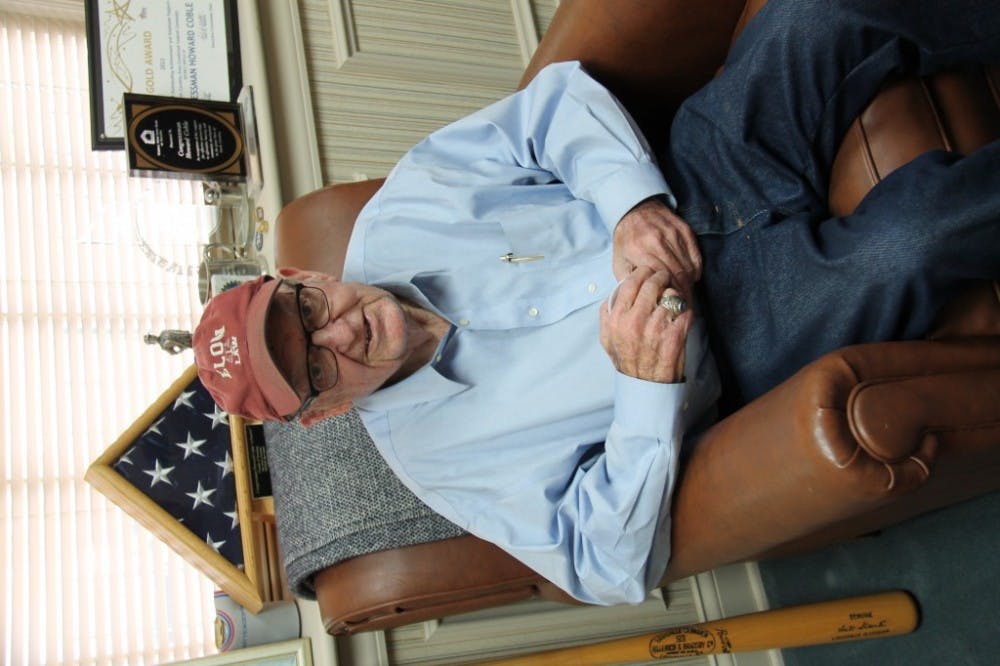
For 10,891 days Rep. Howard Coble (R-NC) has represented North Carolina in the U.S. House of Representatives. After 47 years of service in local, state and national government — 30 of those years as a U.S. Congressman for the state’s sixth congressional district — Coble announced his intent to retire at the end of his term.
Coble has seen Greensboro evolve from a sleepy town with furniture factories, textile mills and tobacco fields into the third-largest city in North Carolina with suburbs, an increased population and a downtown.
Born in 1931 in a Guilford County’s rural agricultural community, Coble grew and developed with the city. While he has seen many changes in his hometown, some things have remained constant-he grew up with the Alamance Church Community, the same church he attends today, more than 80 years later.
Coble received undergraduate credits from Appalachian State University and Guilford College, later serving in the Coast Guard and returning to earn a degree from Guilford. After pursuing his law degree at the University of North Carolina at Chapel Hill, Coble held various positions in the state legislature before running for the House of Representatives, such as Assistant U.S. Attorney and Secretary for the Deputy of Revenue.
Coble said that an unbalanced voting ballot, with far more Democratic than Republican candidates, motivated him to run for the state legislature in 1968.
“I feel that in a republic where there are two major parties, as is the case here, I think the constituents are better served if you have both parties nipping at each others heels, fighting, debating the issues,” Coble said. “There’s nothing wrong with that.”
While a congressman for the U.S. House of Representatives, Coble ran and was elected 15 times. He continued to run his campaigns to create a more balanced voting ballot.
As a congressman, Coble chaired U.S. House Judiciary Subcommittee on Courts, Intellectual Property and the Internet, which worked with patents, trademarks and copyrights. He felt his presence on the committee played an important role for the future of inventors.
“Intellectual properties provide such a favorable role in their operation. I think that many people benefit as a result thereof without knowing it,” Coble said. “Inventors need protection, and that protection is provided for them by statute. I am proud of our work there.”
Looking back on his career, Coble said his main regret was his vote to dispatch troops to Iraq.
“I don’t think we had a solid post-entry strategy,” Coble said. “I think we went in and we went out too quickly.”
He announced that he would not be accepting his congressional pension of about $2 million, and he said he hopes this will be his legacy.
“[Refusing my pension] will be costly, but my point is that most taxpayers pay my salary,” Coble said. “I don’t think they should also have to pay my congressional pension.”
The idea of taxpayers also paying for a congressman’s pension is an important matter to Coble, so much so that he introduced a bill that extends the service time for a member to be eligible for a pension from five years to 12 years. The bill hasn’t had any support or backing. Coble said when he introduced the bill last session it was similarly ignored, and no one wanted to embrace the issue.
Soon, though, Coble will not be involved in congressional sessions and bills. With his retirement to begin after a new official is elected in November, Coble looks at his future and sees a lot of free time.
“Someone recently said to me, ‘For 30 years you’ve had no spare time. Soon you’ll be in a position where you’ll have nothing but spare time, you better think about it.’ I said, ‘I’ll start thinking about it tomorrow but as the old adage goes, tomorrow never comes.’”