

Worshiping for 125 years. Elon College's rich history of religious life is apparent in every aspect of the Elon experience.
The college was founded in 1889 in conjunction with the Christian Church. From the very beginning, Chapel Service took place daily, and students were required to attend.
For more than 100 years, Elon students were granted academic credit for attending chapel, as well as approved cultural programs. If a student attended a minimum of 30 of these events each year, they would earn one semester hour credit.
In the fall of 1962, Elon College reduced the attendance policy, making it a requirement to attend chapel one day a week. Freshmen typically attended chapel on Thursdays, while upperclassmen attended the Friday services. By 1985 that requirement was waived.
For the first number of years, all of the religious organizations on campus were based in Christianity including YMCA, YWCA, College Sunday School and the Ministerial Association. Elon University now has 17 religious organizations, including Hillel, Young Life and the Elon Secular Society, an organization that caters to the Atheist and non-religious at Elon.
Richard McBride served as college chaplain of Elon College and University from 1984 to 2009.
In his tenure, Elon's initiative to grow as a more religiously diverse campus was put into action. Luminaries, the plans for the Numen Lumen building as well as Hillel began under his leadership.
"One time when I said to the faculty that our students come from more religiously diverse high schools than the university that they've come to when they arrive here," McBride said.
"That set in motion some efforts to try and bring more of the religious diversity to campus," he said.
Promotion of multi-faith beliefs is a cornerstone of the Numen Lumen pavilion. Unlike Elon's early years, Catholicism is now the most commonly identified religion amongst the student body.
Father Gerry Waterman has served as the Catholic Campus Minister since 2002.
"This heritage of Elon says this is founded as a Christian school," Waterman said. "We still operate on those principles. The majority of the students are predominantly Christian, but that doesn't mean we can't be open, tolerant and inviting of so many other faiths and traditions to be a part here."
When asked to describe religious life in three words, there was one common response: diversity.
Diversity has been a university initiative since the 1980s.
"It is becoming more and more diverse over time. And with the new building, I'm poised to see more diversity come," McBride said. "The building says, just in its presence, we do invite folks of various traditions to be here, to be welcome here, to be respected here."
Despite the growing diversity on campus, McBride said each religion should still be unique.
"I don't want to see the different groups come together and sort of merge as a stew, I don't like the melting pot idea. Every group deserves its distinctiveness and let its distinctiveness be known, be shared, and be valued," he said.
Hillel Engagement Intern Morgan Goldstein said Elon's goal to be a diverse campus is a work in progress.
"I think the diversity on campus is growing as a whole and it is definitely going to take time and it's not an easy process," Goldstein said. "But I think over time and by everyone working together and communicating it can definitely get there."
Sophomore Waverly Ann Jackson is a member of the Christian organization InterVarsity. Jackson believes the University initiative is working.
"I think Elon is diverse to an extent. I think religiously, Elon is very diverse," Jackson said. "I can just say that from the different religious organizations that I know are offered on this campus and knowing people in InterVarsity that do other organizations, as well."
Students take advantage of the opportunity of the various religious organizations Elon provides.
Catholic Campus Ministry, known as CCM, is one of Elon's largest religious organizations. Father Gerry Waterman said CCM serves as a place where students can learn and reflect on their faith in an inclusive, welcoming environment.
"Your faith is constant," Waterman said. "It's something that doesn't change even though there are minor tweaks here and there, but it's a constant. It's something that is homey, something that feels good, it's like an old sweater or an old pair of shoes."
Waterman said Elon is a place where all are welcome, regardless of religious belief.
"I think on this campus particularly when there is much going on in our world in this day in age, to have a place you call home, a place you feel welcomed, a place you feel like you're not being interrogated, you don't have to perform, you just have to be who you are and you're accepted and loved, that's specific to this campus," Waterman said.
Nancy Luberoff, Hillel director, said 10 percent of the current freshmen class identify themselves as Jewish. Luberoff says that number is the highest she has seen in her tenure at Elon.
"A Hillel center- a building, a building. Which has in big letters "Bruchim Habaim," which says 'welcome, welcome.' It's a very powerful symbol on this campus of saying 'Jews are here, Jews are welcome,' and you have a place on this campus," she said.
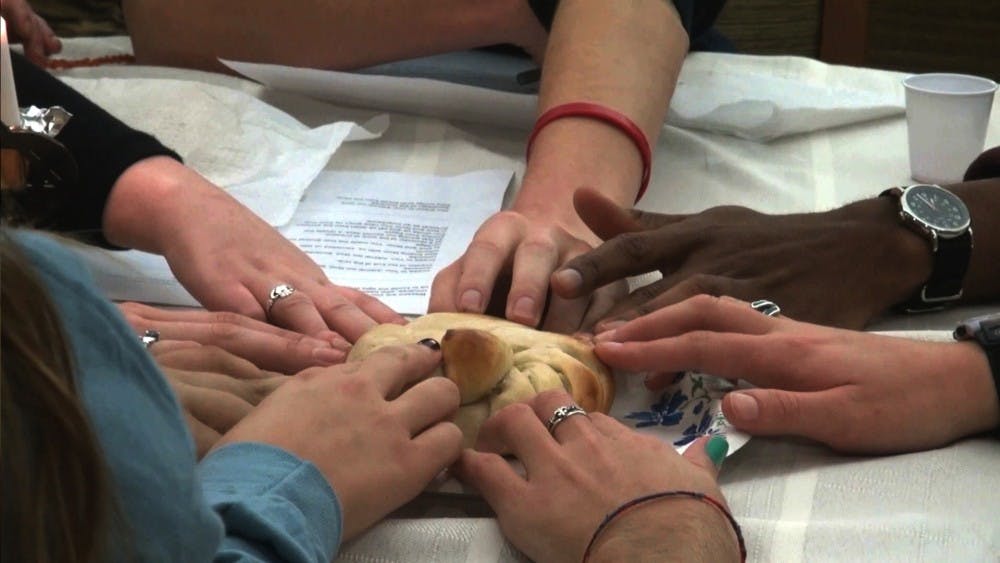
The Sklut Family Hillel House, just over a year old, is a place of worship, camaraderie and lots of food.
"When I started here in 2008, for a bagel brunch, I would usually buy two dozen bagels," Luberoff said.
"Usually one dozen would get eaten. There would be one dozen left. So you can count how many people there are. And at our last bagel brunch there were twelve dozen bagels. And there weren't too many left over," she said.
Adjusting to having a larger presence on campus wasn't easy for Luberoff. But she says what has resulted has exceeded her expectations.
"So for my first few years at Elon, I wanted to be with my family and my synagogue for the high holidays- Rosh Hashanah and Yom Kippur. I wanted to be with my community. And it was really hard for me to be at Elon with students instead of my community. This year, for the first time, I sat at services at Elon and I thought...'this is my community.' This is a real community. This is not a make believe community. This is not a hold your place community, for when you grow up. Or just in between your birth family. This is a real community with our own traditions and values and, that's what Elon Hillel means to me. It means that we are a real community," Luberoff said.
Looking ahead to the future, religious leaders on campus hope for on-campus worship of all kinds.
"I don't want them to have to go off-campus if they want to worship, they can worship right here," Waterman said. "Wouldn't that be a great opportunity? That's my goal for Elon, to have their student serviced, right here, practice."
While religious and spiritual practice is encouraged, University Chaplain Jan Fuller hopes students continue to practice and accept diversity in the years after they leave the bubble.
"What we want is, when you cross the stage at graduation and you shake President Lambert's hand, every single person who does that has had an experience of religious diversity; has learned something about the world that you're going out to live in," Fuller said.