

For students looking for a dance show they can passively enjoy, "Dancing in the Black Box" is not the show for them. This year’s show stretches the lengths of the imagination with dances that experiment with form and dancers' abilities.
The show opened with “Tink,” an original piece by alumni Michelle Amara Micca (Class of 2010). The duet started with the dancers posed like a traditional portrait, with one dancer in the chair and one dancer standing with a hand on the other’s shoulder. “Tink” was a piece focused on the seemingly complex relationship between both dancers; a relationship wrought with anger, pain and at some points, violence.
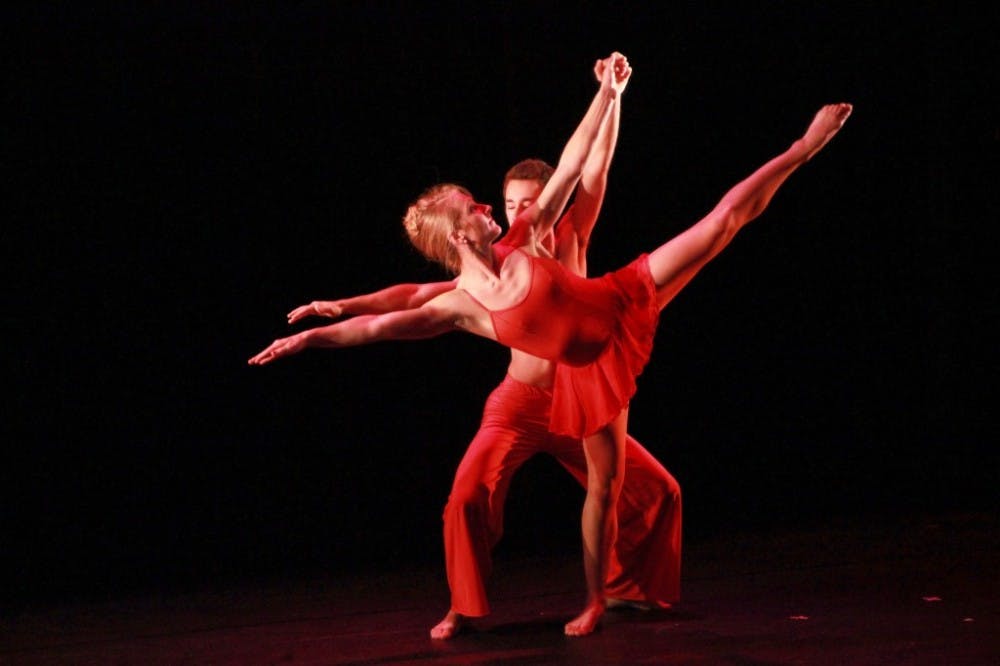
Guest artist Gaspard Louis, invited by director Jen Guy Metcalf, taught a duet piece called “Magical Cusp” took a 180-degree turn from the emotions in “Tink.” Louis’ piece was more sensual and passionate. The chemistry between the dancers was electrifying, which only increased with red costumes and lighting. The duet dancers displayed a terrific amount of strength and flexibility, both of which were necessary because the dance relied heavily on quick partner movement and risky lifts.
Professor of Dance Jane Wellford’s piece, “Letting Go,” allowed dance to communicate with the spoken word. Inspired by her years as an Elon 101 professor, Wellford had her dancers speak to the various pieces of letting go, ranging from isolation to missing home. The dancers interpreted each other’s monologues and, eventually, worked together to represent and then repel the notions of letting go.
The show ended on a high note with Professor of Dance Jen Guy Metcalf’s “Edge,” a tribute to Betty Gold, a Los Angeles sculpturist. The music had a Latin American vibe to it, and the dancers wore red and purple flowing dresses, reminiscent of traditional flamenco dancers. The dance played with lines and levels, and allowed the dancers to show a saucier side. Upbeat and mesmerizing, “Edge” provided a positive finale to the show.
The Black Box Theatre acts as the most suitable host for an emotionally charged and mind-bending show like this. The simple smallness of the space allows the dancers’ emotion and strength to come to the forefront. Under the soft light, the audience can see the pain, the confusion, and the comedy the dancers fully commit to each piece. The dancers portray complex ideas such as ostracism, romance and hatred convincingly, which is a tribute to their professionalism and training.
It would have been easy for the show to feel disjointed or uneven with the variety of skill level among the choreographers. But each piece played seamlessly against one another. The individual performances introduced unique quirks and attitudes, and much like the dancers who performed in them, the dances unapologetically committed to their purpose.
"Dancing in the Black Box" challenges audience’s perceptions on dance from the show's movement to its music to the way it uses its dancers. A show like this could easily fail, but under the direction of Metcalf combined with the maturity and skill of the dancers, it succeeds in challenging the audience to rethink their definitions of dance.