

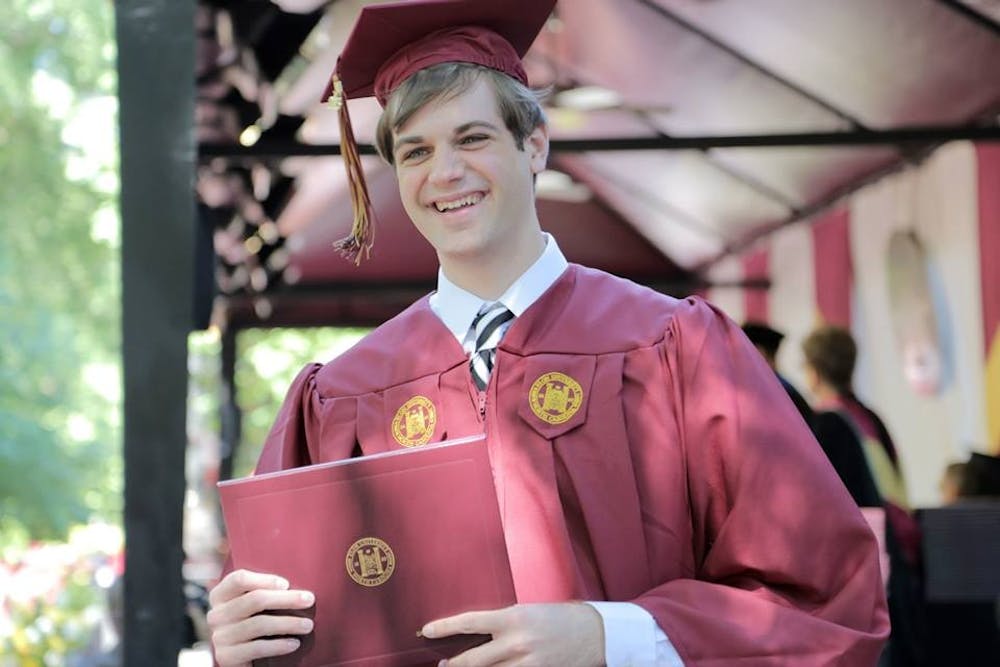
Darien Flowers Bachelor of Arts, Political Science Former SGA Executive President
Q: Where are you employed, and what do you do?
A: I’m a research assistant for Sen. Rob Portman of Ohio and I work in the Capitol. We’re making sure the federal government is working as smoothly as it can. I do research for his committee, write memos, prepare documents for hearings and go to hearings with him. We work on tax reform and other federal issues.
Q: What were some of the biggest surprises of post-grad life?
A: For me, the managerial component of my job was a surprise. Having a junior staff answer to me was something I had already experienced [as SGA Executive President], but I wasn’t expecting to have that kind of responsibility. You have to make sure you’re being an effective manager. Are you communicating the task properly? Are you supporting them in the best way possible so that they can be successful? On a lighthearted note, waking up at 6 a.m. to go to work while we’re in session was a bit of an adjustment.
Q: What were some of the obstacles you faced?
A: Figuring out your role in the office and making sure you’re doing your job well is a challenge. You have to understand the dynamic of the workplace and how to fit yourself seamlessly into that organization. Also, the turnaround of my position was really fast. I got hired a week before we graduated, and had to be there two weeks afterward.
Q: How did you overcome those obstacles?
A: The chief of staff told me, and the office as a whole, to focus on how we can do our positions to the best of our abilities. If I’m writing memos and answering phones, I need to do that as well as I can. It’s important to be humble enough to take a step back and observe how coworkers communicate with each other and work together so you can figure out how to best support the goals of the organization.
Ali Deatsch Bachelor of Science, Physics Varsity Volleyball player, Lumen Scholar
Q: Are you employed, and if so, what do you do?
A: I don’t have a job. I started graduate school in June instead. I’m pursuing my Ph.D. in physics at the University of Notre Dame. It’s nice because I’m pretty close to home and the school has been great so far. It’s a lot of work, but it’s worth it.
Q: How is life after college different than what you anticipated?
A: Life after college is so much responsibility. I suppose I expected that, but you don’t really know what it means until you’re there. And I’m still a student so it’s not even really the real world yet.
Q: What were some of the biggest obstacles you faced?
A: One of the biggest obstacles for me was finding a place to live in a new location that I didn’t know well where I didn’t know anyone. Finding a safe place that I could balance in my budget and close to campus and whatnot. It was complicated. This is going to sound cheesy, but one of the other biggest obstacles has been realizing I’m not going back to Elon. I miss it already and it’s been so weird to adjust to a different school. I’m so jealous of my younger friends headed back soon and my teammates back there for preseason already.
Elliot Luke Bachelor of Arts, Media Arts & Entertainment with a Cinema Concentration
Q: Are you employed, and if so, what do you do?
A: No, I’m not employed. I’m looking to start off doing production assistant work on sets and really find what it is I would like to do in the entertainment industry, but the way things are looking right now, I will most likely be freelancing audio and sound work on sets and DJ-ing on the side.
Q: What kinds of positions have you applied for?
A: Everything! Editor, director of photography, production of assistant, composer/sound design, boom operator, A/V tech jobs and many more. I have applied to any job that consists of work that I have had experience in. I recently applied for a position for a TV show where I would be a DJ and improvisation performer. So that gives an idea of the breadth of jobs I’ve applied to in my month or so of being out here.
Q: What are some of the biggest obstacles you’ve faced after graduation?
A: Money, for one. If you don’t have enough saved up, you’ll be looking for help in any way you can get it. Without a job, you can’t make money, but it’s difficult to find a job, too. Making connections is also difficult. It is undeniably the most important thing you can do out here in LA. You will be hired based upon who you know, or more, who knows you. It is extremely difficult to get any job without knowing anyone in the company first, and it really proves that networking is everything out here in LA.
Q: How have you been managing that?
A: As for money, I had enough saved up to keep me going for a while, but my parents are helping me with a loan for now, too.
Q: What are some of the biggest surprises of post-grad life?
A: It’s a difficult but extremely rewarding time in life. In college, you think you’re so grown up, but it really becomes a reality you face every day that you’re on your own once you graduate. The more connections you make, the better, and it doesn’t matter if it’s a stretch. Sometimes those end up being the best connections to have. Persistence is key.
Greg Brzozowski Bachelor of Arts, Media Arts & Entertainment One on One Sports, Elon Phoenix Weekly
Q: Do you have a job? If so, what is it, and where are you located?
A: I’m the new weekend sports anchor and multimedia journalist for WJHG-TV, the NBC affiliate in Panama City, Florida.
Q: How is life after college different than what you anticipated?
A: The biggest difference between expectations and my reality of life after college is how real everything gets so fast. These realities are all things I knew would be difficult. Jobs aren’t handed out, it’s tough to be away from friends, responsibilities will multiply, but when faced with these challenges directly, you realize you’re not in school anymore. It’s tough to land a job when employers won’t even look at your resume, yet it feels like everyone else around you is off to work already. The friends that you turned to for support at school aren’t living next door. Instead, they’re living in the next state. And when that offer does come in and you make your move to your job, bills are no longer a future problem, but how you’ll use up the majority of your entry-level salary.
Q: How have you overcome some of these obstacles?
A: Overcoming these obstacles is tough, but the best way to get past them is to stay positive, stay patient and stay in touch. The moment you get down on yourself in your job search and let the rejections get to you is the moment you lose your way. You’ve worked hard for this opportunity the past four years and negativity only keeps you from being at your best. As someone who fought staying right mentally while being passed up for job after job, I know how tough this is, but the chance will come. That leads to my second point: Stay patient. A mentor of mine told me during my search, “Every ‘no’ you hear in your job search brings you closer to your first ‘yes.’” I never knew before this process how truly important patience is, and at times I hated patience with a passion, but it’s as vital a tool as any when pursuing your goal of employment or goals in general.
Q: Do you have any other advice for post-grad life?
A: Stay in touch, meaning never stop communicating with the people who got you to this point. Internship supervisors, professors, mentors, family and friends. From job advice to life advice, these are the people who are looking out for you and want to see you succeed. Never underestimate the power of networking, or a handwritten thank-you note.