

Updated as of Nov. 13 at 10:012 a.m. to include video.
When working at the Burlington Times-News as a crime reporter, Elon alum Natalie Allison ’13 never expected she would one day be flying on Air Force One as a member of the Washington Post White House press team.
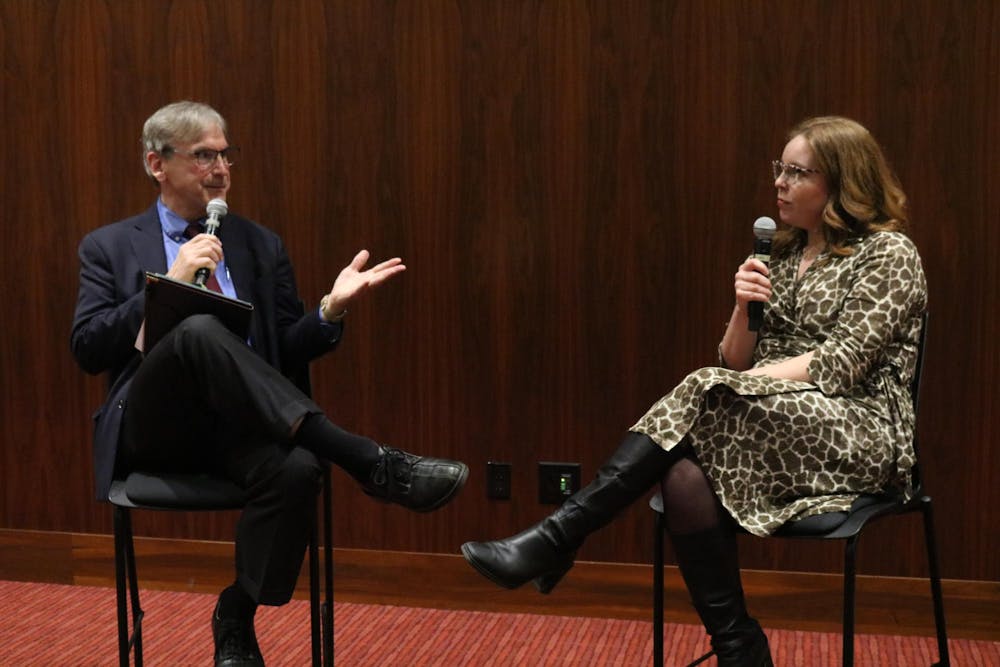
Allison spoke to attendees at Elon University on Nov. 10 in Turner Theatre, talking with Chair of the Journalism Department Anthony Hatcher about her journey to The Washington Post, her time as a reporter, and the role of journalism in politics.
The event was sponsored by the School of Communications, Kernodle Center for Civic Life, Student Media Board and other campus departments and organizations.
Elon sophomore Ainsley Thompson is a Change Maker Scholar, a program for students interested in civic engagement, and came to the event because the program required it. She said even though the event was mandatory for her, she was interested in learning about political journalism and its impact.
“Change Makers is based on service and helping others, and being inside of things is one of the most impactful ways that you can help other people,” Thompson said. “I think this is the program’s way of having us learn how these kinds of things work.”
Allison began her journalism work at Elon News Network, where she became managing editor for The Pendulum. She went on to work at the Burlington Times-News, the Tennessean and Politico.
Allison received national recognition for her political reporting at the Tennessean, covering white supremacy movements in the state and fraud scandals surrounding the Tennessee State House Speaker, Glen Casada.
Her time at Politico featured lengthy reporting on the 2024 Republican Primary, as well as extensive coverage of Donald Trump’s 2024 campaign. Shortly after President Donald Trump was sworn back into the White House, Allison joined The Washington Post White House reporting team.
Allison said the first Trump administration was a much more sensationalized time to be a White House reporter, as press leaks from the White House would lead to stories. Allison said now that Trump’s cabinet is more tightly knit, it’s harder to get a lot of information.
“Unless you're a communications professional for the White House, there's not as many White House staffers leaking information to reporters or meeting with reporters,” Allison said. “Now it's people sticking to talking points and going through official channels.”
While serving on The Washington Post White House press team, Allison has been able to travel with the president to cover national and international events, recently following him on his trip to Asia to meet with foreign leaders.
Allison said she never expected to be at this point, but that her experience being involved in student media gave her the skills that led her where she is today.
“It really shows that your first job doesn't have to be in D.C., it doesn't have to be a national outlet,” Allison said. “You can really work your tail off and still get there.”
Allison said that the most interesting story she’s covered was a Black Lives Matter protest in Nashville that turned into a riot. Windows were broken, light poles were torn down, the city hall was set on fire, and Allison said she was tear-gassed along with other members of the crowd.
“I’ve never been a war correspondent, that was the closest moment I’ve ever had to it,” Allison said. “I think those kinds of experiences, those demonstrations where you see them up close, it's not the kind of thing people see every day, and it does feel sort of surreal being in the middle of it.”
Allison said despite the field of journalism changing over the past few years, the core of journalism has remained the same. She said political journalism still acts as a watchdog for those in power, and can lead to changes in policy.
One example of the power of political journalism that Allison reported on was a bronze bust of a Confederate general and Ku Klux Klan leader in the Tennessee state capitol building. While many legislators had asked for the bust to be removed, former governors never removed the bust, despite saying they would eventually. The governor who ended up removing the statue was current Tennessee governor Bill Lee.
Allison had covered Lee’s campaign for governor, including his platform of preserving Confederate monuments. She believes that while Lee may have had a change of heart on the subject, the constant coverage of the bust and its controversy acted as an influence in getting the bust removed.
“The questions you're asking are shedding light on something that the government certainly doesn't want you to shed light on, but they know when it's out there, they're going to have to answer to it, and a lot of times that means saying they're going to change the law,” Allison said. “It's a really powerful example of the importance of journalism.”