


When Elon University started its current strategic plan in 2010, the university stated its goal to triple the number of international students — those holding non-immigrant visas — by 2020. While the goal has not yet been reached, Elon is more than halfway there.
Director of International Student and Faculty Scholar Services François Masuka said Elon currently enrolls 120 students on visas and more than 100 other students with dual citizenship. With 51 more international students needed to meet Elon’s goal, the university has begun to recruit more extensively outside the country.
One and a half years ago, Elon hired Mandy Herrera '10 as assistant director of international admissions. There had only been one previous counselor dedicated to recruiting international students, and that person also served a territory within the United States.
“That’s a lot of pressure for one person,” Masuka said.
With the hiring of Herrera, Elon is focusing on expanding its recruiting efforts to industrialized countries.
“We have started to focus more on China, India, and Brazil — where research shows an upward trend in students coming to the U.S. for college,” Herrera said.
In addition to targeting a broader range of countries, Elon is beginning to recruit different types of schools abroad. In the past, Herrera said Elon targeted American or international schools.
But over the past year, the university has started targeting national schools. Although Elon primarily focused on recruiting students who attended English-speaking schools, it is now looking at schools where English may not necessarily be the language classes are taught in.
As Elon continues to work towards tripling its international population, admissions is focused on implementing new strategies to attract students.
“We are covering more ground, boosting and personalizing our communication flow to our international population and thinking of more innovative and effective ways to connect with students,” Herrera said.
Video Clip: Raphael Higuet, an international student from Belgium, discusses adjustment to American culture and life at Elon.
While Masuka explained the increased dedication to international recruitment has helped the university and students, he noted the university’s brand and location has not been well established in the international community.
“Not many people overseas know where Elon, North Carolina, is, so many people who are looking to come to the United States are thinking about New York or they’re thinking about California or Boston,” said Woody Pelton, dean of global education. “It is a challenge that North Carolina — and in particular Elon — is not a known quantity in most places around the world.”
Video Clip: Pelton explains challenges Elon faces in recruiting international students.
A less known brand hurts the school because it is often an important factor for the international community.
“In many countries, name recognition and rankings are very important to them,” Herrera explained. “A lot of what we do [as admissions officers] is explain the value of a liberal arts education to them, as well as the U.S. higher education system in general — which often is a foreign concept to them.”
Elon’s high tuition cost can also be a prohibitive factor when admitting international students. Non-US citizens are not eligible for financial aid from U.S.-based scholarships. While Herrera says she finds plenty of qualified and interested students, they are unable to attend the school for financial reasons.
Without a strong endowment compared to many of its peer institutions, Elon is behind when it comes to attracting a socioeconomically diverse group of international students.
“There is not much scholarship money directed towards international students, so that’s a challenge,” Pelton said. “Some of our peer and aspirant institutions have more scholarship money that can be offered to incoming international students. We are limited in the dollars we have available, but we have some available.”
cq mb
“My English wasn’t that great when I came here, so it was a tough part,” Higuet said.
After non-citizens are accepted to Elon, they must go through the process of obtaining an F-1 student visa — unless they are applying on exchange in which case they would get a J-1 visa.
Masuka explained how the most difficult part of this process is that the student wishing to study in the United States must prove they do not intend to abandon their home country.
After all the relevant admissions documents have been submitted and approved, Elon works to get the students on campus before the rest of the student body. The university holds an international orientation before classes begin.
“International students have to come before general orientation so we can explain to them what it is like here,” Masuka said.
Pelton said one of the major focuses in the orientation talks is the difference in education systems between the U.S. and other countries.
The international orientation also helps to ensure students have what they need to be prepared to live away from their parents. In addition to helping explain the different expectations of the American education system, Masuka says international orientation is used to help students know where to get the food they need and how to set up bank accounts.
Once international students have completed their separate orientation, they go on to general new student orientation which further explains life at Elon.
“The repetition of some of the things we talk about will come from our colleagues in new student orientations,” Masuka said.
Life at Elon and beyond
After international students have settled on campus, Masuka’s office offers general support.
“When they have trouble adjusting, I provide support,” Masuka said. “When there are immigration issues, I provide support.”
Audio Clip: Higuet explains why he chose to attend Elon and what his first impressions were.
Masuka said he will take international students to the hospital when they are sick because transportation is often one of the biggest issues they face. Elon’s location away from public transit makes it difficult for international students — many of whom come from countries with advanced mass transit systems.
Masuka’s office also organizes events for international students and travels to the International Festival of Raleigh. He estimates 70-80 percent of international students participate in these programs in some capacity but would like that number to be even higher.
“My goal is to make this 100 percent," he said. "Will I get there? Realistically, no. But I want the students to know the resources are here. They already paid for them."
Elon also has a program called Phoenix Pals that pairs international students with domestic students who they can reach out to for advice on adjusting to life in America. Junior Dawson Nance, president of Phoenix Pals, said the organization was on hiatus during the fall semester so it could be revamped to attract more students.
Video Clip: Nance explains support services offered to international students through Phoenix Pals.
As international students spend more time on campus, they may get more comfortable. But they lack some of the opportunities that domestic students have. Because international students often attend thanks to visas, they are not allowed to take non-credit internships. Although they can work on campus, they are limited to 20 hours a week while classes are in session.
Once a student on a visa graduates, they can stay in the U.S. for 12 months through a program called Optional Practice Training. This allows them to gain work experience though the program has specific requirements.
“It has to be in your field of study," Masuka said. "If you are in business, you can’t get a job at McDonalds."
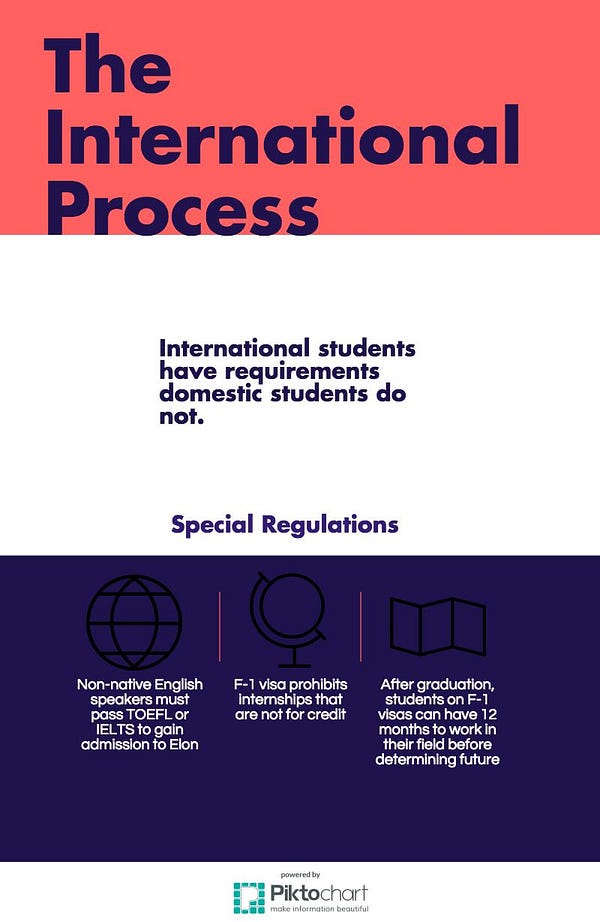
With the work limitations of student visas, an OPT can be invaluable experience.
“Many international students have never worked and they need something to put on their resumé for when they graduate,” Masuka said.
Elon has increased its efforts to make international students aware of this program to good results, according to Pelton.
Once a person completes an OPT, they are faced with several options. They can go to grad school and remain a student, find an employer willing to sponsor them for a work visa or leave the U.S. and return home. If a person decides to return home, they are allowed to stay 60 days before leaving.
Even if international students cannot remain in the United States, Masuka wants to make sure Elon has left its mark on them.
Josh Markowitz contributed to this story.