

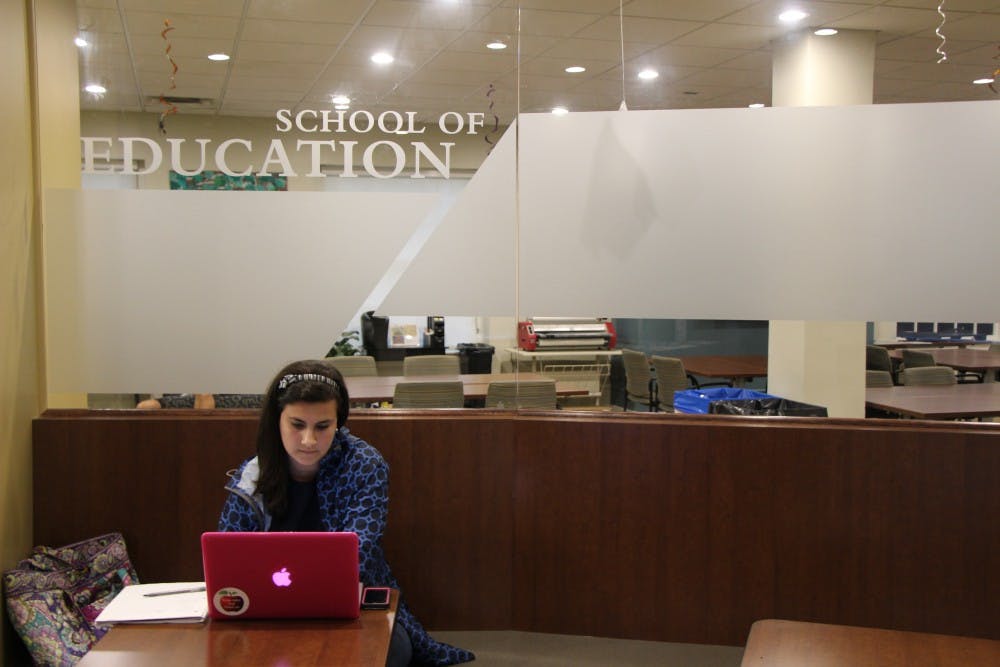
While the number of students receiving education degrees has declined in the past decade, the School of Education has added minors to attract more students to the department’s curriculum.
Decline in degrees
According to the Elon University Fact Book, the number of Education majors has decreased from around 100 students to 60 within the last decade. The School of Education includes undergraduate degrees within two departments: Education and Health and Human Performance.
Deborah Long, interim dean of the School of Education and professor of education, said the “why” is complicated.
“[The decrease in Education majors] is caused by the working conditions, public sentiment and lack of financial support,” Long said. “The testing also makes it very difficult to be creative and actually put into practice what you learned in your teacher education programs.”
The cost of Elon is another possible reason behind the decline of education majors. Since teachers receive low salaries, students may have to deal with more substantial student loans or debt for an extended period of time compared to other majors.
“The tuition, room and board at Elon is pretty stiff,” Long said. “Coming to Elon and being a teacher, a lot of students from North Carolina may opt to attend state schools instead because they will come out with fewer loans.”
According to Richard Mihans II, chair of the Department of Education, the information in the Fact Book might not reflect the actual number of students graduating from the School of Education. Some students choose to major in other areas but still obtain licensure, he said.
“We’re working with the registrar and Office of Institutional Research to count students in [our department],” Mihans said.
Senior Emma Lindsay, who hopes to become an Exceptional Children (Special Education) teacher, realizes many people have the “those who can’t do, teach” mindset in regard to the education profession.
“Teaching is lowly regarded when it comes to being an actual profession,” Lindsay said. “Other professions view teaching as something to do when you can’t do anything else. That is far from the truth, but unfortunately, it is what most people believe.”
The decrease in education majors is not just an Elon issue — it is effecting both the state and the nation. WBTV reported a 20-40 percent drop in enrollment to schools of education across North Carolina colleges.
Because of the lack of teachers within the United States, there is a higher demand for certain types of education professions in the workplace. In a 2014 article, Western Governors University predicted a need for 440,000 Special Education teachers by the year 2020.
“Of course I am worried about getting a job after graduation,” Lindsay said. “But, at the same time, EC teachers are always in demand, and the teacher turnover rate in many states is high. If you look in the right places, there are positions open with children who are waiting to be loved.”
Adding minors
Despite the decline in education degrees, students interested in the education field have added minors in recent years.
Mihans said when the school noticed that fewer students received education degrees, it adapted by adding minors.
“The classes were packed, especially in 2006 to 2008,” he said. “We weren’t really concerned, and we were in our own bubble. That jolt of decline was good for us. It was an opportunity to say, ‘How can we benefit other students on campus?’”
Within the past two years, the school has added three minor programs — adventure based learning, teaching and learning and wellness and health education. With these programs, the school now has five interdisciplinary minors.
Before adding minors, most education classes were only open to majors. Now — with more than 100 students pursuing education minors — classes have a mix of students.
Long said students are interested in the minors for several reasons. She said they help prepare those who want to enter post-grad programs, such as Teach for America and the Peace Corps. She also believes the minors help students navigate education policy.
“Every student has a stake in health and education,” Long said. “Everyone is going to be a taxpayer, and many will have leadership positions. It’s important for students of Elon to have knowledge of those things. The best way to do that is with minors that work with other majors.”
Students with minors in the School of Education have different majors, ranging from African-American studies to journalism.
Junior Emily Ciuffetelli, a theater studies major, chose the teaching and learning minor to pursue her passion of education through the arts.
“I think it’s great, especially for my specific needs,” Ciuffetelli said. “I knew I wanted to integrate education, but I didn’t want to be a double major.”
Junior Shelby Allen, a human service studies major, is also a teaching and learning minor. She said the minor gives her a chance to learn about the education field without necessarily preparing her for a classroom setting.
“I want to be a counselor, working individually with students,” Allen said. “The education minor would help me make a track in my major because it’s so broad.”
But as one of the first students to declare the teaching and learning minor, Allen said there have been some drawbacks.
“Because I’m not an education major, I don’t have the background that other students have,” Allen said. “I go into the 200-level or 400-level course, and students use terms I’m not used to.”
Attracting students
To attract people to its programs, the school created a recruitment committee two years ago. Faculty and students on the committee inform others on campus through several efforts, including College Coffee tables and digital signage.
The School of Education also offers a Teaching Fellows program, which prepares students for teaching and receiving North Carolina licensure. Teaching licensures provided by Elon are valid nationally, not just in the state of North Carolina.
“Our Teaching Fellows program is great,” Long said. “A lot of times people who interview for the Teaching Fellows that don’t get in [the fellows program] still come here because they are so impressed with our education program at Elon.”
But even with the additional new minors and other promotional aspects, Long believes that no one should be forced into teaching if it is not their true passion.
“I wouldn’t want to recruit anyone into teaching unless that is really what their passion was,” Long said. “It is a challenging profession but very rewarding. Teaching is missionary work. It’s a calling, not just a job. It has never to me been about the money. It has always been about the work.”
As a teacher, Lindsay wants to make a difference in children’s lives both academically and personally.
“I believe that each and every student needs to know that someone is there to support and love him or her,” Lindsay said. “Through teaching, I can help children see strength and potential that they did not even know was there.”
Long hopes the tide will turn and teachers will begin to earn the proper respect that other professions already receive.
“People need to start thinking about education as an investment,” she said. “We got to wake up and realize that we have to make this investment in our futures.”