

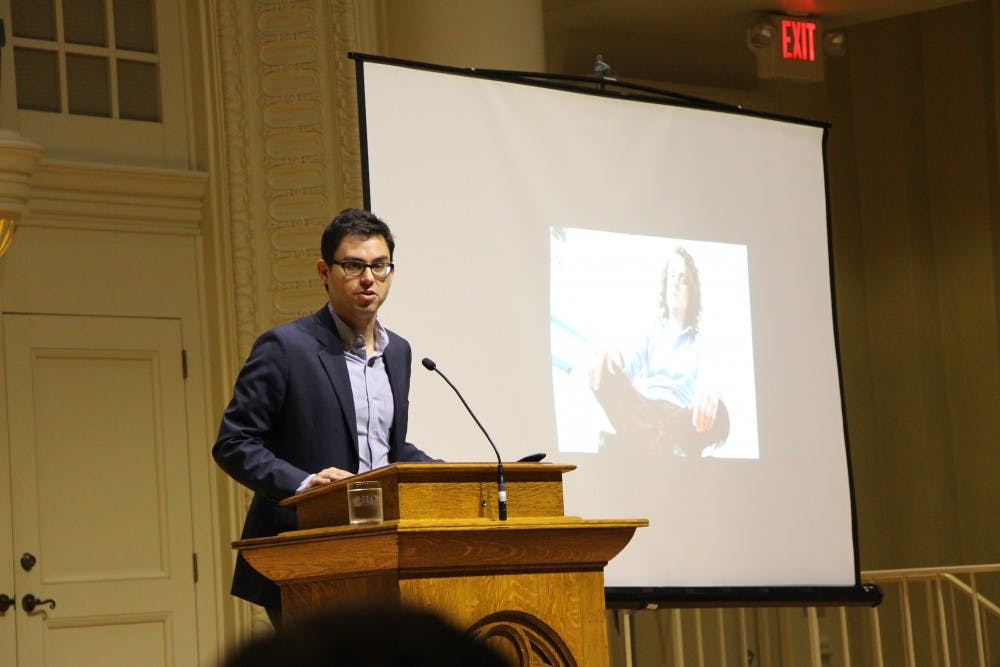
Science journalist Joshua Foer showed a half-packed Whitley Auditorium audience a list of 100 random words. He then issued them a challenge.
“If I gave you 100 random words and gave you 15 minutes to remember every single word on that list, could you do it?” Foer said.
For his speech “Nature of Memory” Wednesday, Foer talked an audience of Elon University faculty, staff, students and community members through his history with memory techniques.
The journalist became a memory expert by turning a routine job assignment into a passion for learning to improve his memory. He was sent on assignment by Slate Magazine to the United States Memory Championship. There he found people memorizing numbers, first and last names of strangers, poems and entire decks of cards in two minutes.
“Everyone who competes in the contest all have average memories,” Foer said . “They trained their memories. Everyone there knows about those memory techniques, techniques that were forgotten about.”
That got him thinking. To cover the Memory Championship story, he immersed himself into the life of a memory contestant. He even bought old high school yearbooks from Goodwill and tried memorizing the students' first and last names every morning.
“I actually found it fun,” Foer said. "It wasn’t about training my memory, it was training my creativity that I don’t normally recognize.”
Foer's newfound interest in memory tricks inspired him to return to the memory competition, but this time as a contestant rather than a journalist. Unexpectedly, he won the contest and established the new U.S. record for fastest memorization of a deck of cards: one minute and 45 seconds.
“It was interesting to learn about how just an average man, who never planned on memorizing anything, could win the memory competition,” said freshman Danny Wallowicz . “It just shows that you don’t have to be a genius.”
During his talk at Elon, Foer didn't just explain his own history with memory techniques — he also presented to the audience a variety of memorization tactics commonly practiced by contestants at the championships he attended as a journalist and a competitor.
One contestant at the first championship he attended taught Foer some of his techniques, such as a trick to put names to faces quicker.
“The first rule of memory is you have to be paying attention,” Foer said. “The second trick is to somehow associate that person’s name with a physical presence. How do I connect something that’s memorable to its name?”
He also learned a technique called the memory pyramid, which helps people remember large numbers by correlating each number with a consonant.
For example, a person wants to remember the number 92. Nine is paired with the letter “p,” while two is paired with the letter “n.” Creating a word such as “pen” allows the person to remember the number easier.
“The memory competition is similar to an arms race,” Foer said. "Every year someone comes up with a technique that allows you to cram as much as you can in your head, and then everyone ends up using that technique.”
By creating unique relationships of memorized content based upon use of ancient techniques, Foer said memorizing anything is a possible feat. People are generally better at memorizing visual words rather than concrete information. They also remember the first and last things they hear in a conversation or discussion.
“Make information weird, colorful, sexy, funny and emotionally resident,” Foer said. “Something that riles you up.”
Freshman Kaitlin Welch found his speech insightful and helpful in terms of improving study habits.
“I learned many things,” Welch said. “The unique techniques that Foer demonstrated to us tonight are techniques that are applicable to our study habits here at Elon.”
Foer ended with the idea that improving and strengthening memory comes from within.
“They are just tricks at the end of the day,” Foer said. “These tricks work because they make you work, they are forcing you to pay attention and make it meaningful in an artificial way.