

For 15 years, she was in a bunker in Indiana, forced into an underground cult and brainwashed to believe the apocalypse had come. Newly freed, she makes a life for herself in New York City, and hilarity ensues.
Netflix debuted its newest original series, “Unbreakable Kimmy Schmidt,” March 6. Co-created by Tina Fey, the comedy stars Ellie Kemper, known for her roles in “Bridesmaids” and “The Office.” Kemper plays 29-year-old Kimmy Schmidt, who has been newly hired as housekeeper for a wealthy family and is rooming with a struggling wannabe Broadway actor.
Supporting cast members include “30 Rock’s” Jane Krakowski as self-absorbed trophy wife Jacqueline Voorhees — Kimmy’s new boss — Broadway star Tituss Burgess as Kimmy’s sassy, over-the-top roommate Titus Andromedon and legendary actress Carol Kane as Kimmy and Titus’s cranky and semi-senile landlord Lillian.
“Schmidt” has an underlying dark premise, as Kimmy is haunted by the memories of the cult led by Richard Wayne Gary Wayne, played by Jon Hamm.
Despite her twisted backstory, Kemper’s cheery, infectious personality lights up every scene and steals the show. Quick-witted humor, hilarious plot lines and a remarkably talented cast has made “Schmidt” a light-hearted, binge-worthy show.
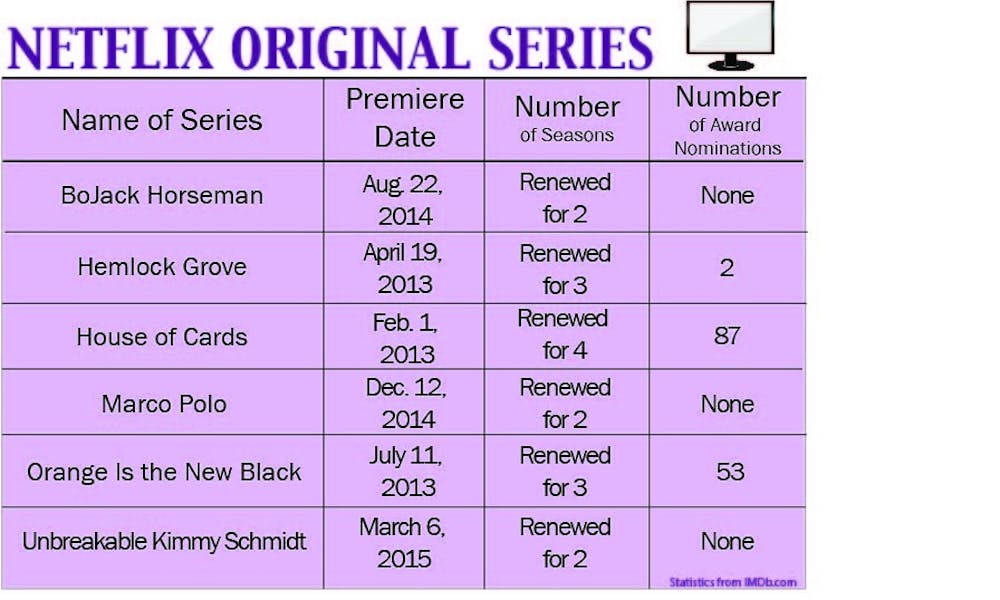
The show has been on Netflix for less than two weeks, but ratings and reviews seem to be going in the same positive direction of other Netflix originals such as “Orange is the New Black” and “House of Cards.” These Netflix shows have been nominated for Golden Globes and Emmys and have pushed the boundaries of traditional television watching.
“Schmidt” and Netflix may not intentionally be creating a media shift, but they are contributing to a modern-day media nightmare — the decline of network ratings.
The comedy was initially airing on NBC. According to NPR, NBC “declined to put it on its schedule,” and shortly after, Netflix picked up the 13-episode first season. NPR television critic Eric Deggans believes NBC is moving toward comedies with larger audiences, attempting to mimic the success of shows such as ABC’s “Modern Family” and allowing Netflix to pick up shows with smaller target audiences.
Netflix’s having shows with big, recognizable names behind them, such as Kemper and Fey, allows for greater interest and subsequent increases in Netflix memberships.
According to CNN Money, 4-in-10 American households that own traditional televisions also subscribe to online streaming services such as Netflix, Amazon and Hulu Plus. This is bad news for networks — Nielsen ratings say 36 percent of American households subscribe to Netflix, and this percentage is increasing.
Asynchronous media is becoming the norm because it fits more easily into the American lifestyle of fast-paced multi-taskers. People simply do not have time to sit down and watch live, scheduled television. They prefer to watch on their own time.
In the 18- to 24-year-old age range, according to Business Insider, television viewing has dropped 16 percent within the past year. The number may seem low, but it is rapidly increasing, and the Cabletelevision Advertising Bureau said as much as “40 percent of TV-rating declines” can be attributed to streaming services.
Companies are becoming more aware of the influence that online streaming services have. HBO announced March 9 that they will be releasing an exclusive partnership with Apple that will allow members to stream HBO on their Apple devices, rather than paying for the HBO premium channel with their cable provider.
“Schmidt” has been praised by the likes of The Hollywood Reporter and The Washington Post and has already been picked up for a second season. It is an addicting binge watch that combines satire with hilarity and adorable Kemper with outspoken Krakowski and questions where media, and the future of television, is headed.