

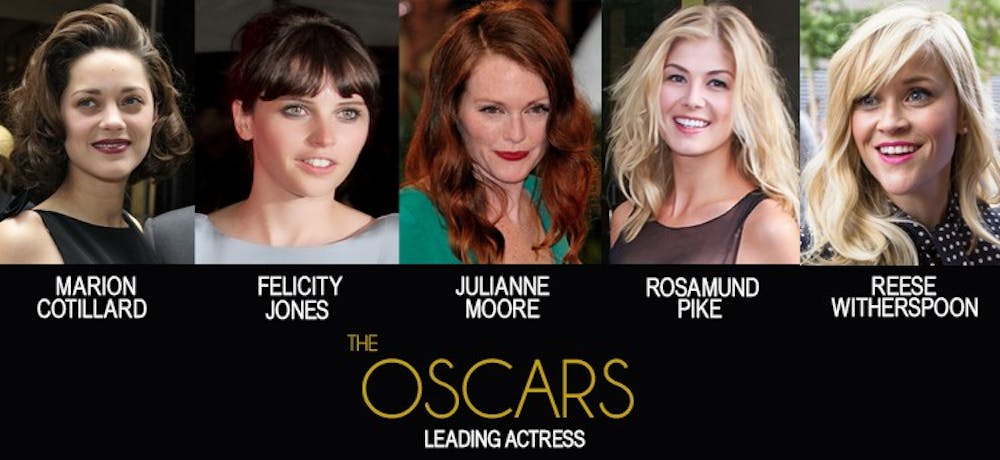
Nomination after nomination for the 87th annual Acadamy Award were released on Jan. 15. However, something was clearly missing from this long list of talent: diversity.
Every actor nominee is white and every writer or director nominee is male. Such a drastic lack of diversity has not been seen since the 70th Academy Awards in 1998. Within minutes of the announcements, #OscarsSoWhite became a nationwide trend on Twitter.
Despite its late arrival in theaters, “Selma” was a buzz-worthy film this year. After receiving four Golden Globe nominations and rave reviews, it received a nomination for Best Picture, but was completely ignored by the Academy of Motion Picture Arts and Sciences in all other categories.
If nominated, Ava DuVernay, director of “Selma,” would have been the first black woman to receive a nomination for Best Director. David Oyelowo, who portrayed Dr. Martin Luther King Jr., was nominated for a Golden Globe but was passed over by the academy.
“The lack of a Best Director nomination for DuVernay is a disappointment not only for those who admired the film, but also for those who see her as a figure of hope,” spoke Linda Holmes in her weekly “Moneky See” segment at NPR. “[Especially] how rare it is for even films about civil rights to have black directors, and how rare it is for any high-profile project at all to be directed by a woman.”
This lack of diversity can be attributed to the films that are being green-lit, or allowed to move forward, according to Kelley L. Carter’s article “The Oscars Are Really While, and It’s Not Surprising” in BuzzFeed.
“Films that center around black, Native American, Latino or Asian characters always are tied to the most challenging elements of history,” Carter wrote. “The same themes are played out on a Hollywood screen year after year...slavery, Reconstruction, civil rights. That’s all you get.”
Carter noted that “color-blind casting” is the key to the future of Hollywood, where all ethnicities can have the ability to play complex and intriguing characters.
In addition to the lack of ethnic diversity, women who were behind the scenes were not recognized. Hollywood is known to be a tough battleground for females trying to make a name for themselves.
According to “Celluloid Ceiling,” an annual report that tracks women’s progress in the film industry, only 17 percent of behind the scenes film workers in 2014 were women, and only 7 percent of directors were female.
The Best Director nominations were comprised of all men, as Angelina Jolie, director of “Unbroken” and Laura Poitras, director of “Citizenfour,” were dismissed. All eight Best Picture nominations were stories about men. Although “Still Alice” and “Wild” featured female character received Best Actress nods, they were unacknowledged in the Best Picture category.
In 2012, a Los Angeles Times article noted Oscar voters were 94 percent white, 77 percent male and a mere 14 percent were less than 50 years old. Jorge Rivas, a national affairs correspondent for digital news platform Fusion, noted that in the last 20 years, 67 of the 80 Oscars for Best Actor awarded to men were white.
The correlation between the demographics of the academy and the Best Actor winners are clearly not a coincidence. The film industry itself is primarily white and male, something that needs to be changed.
While it must not be forgotten that “Selma” was nominated for Best Picture and extremely talented and courageous women were nominated in the Best Actress categories, the academy and Hollywood need to undergo a change. Long gone are the days when black actors were simply a mockery in minstrel shows or women were viewed as the inferior gender. These marginalized groups deserve equal recognition.
The film industry needs to promote an equal society, where diversity is revered, women are breaking glass ceilings and anyone can accomplish greatness.