

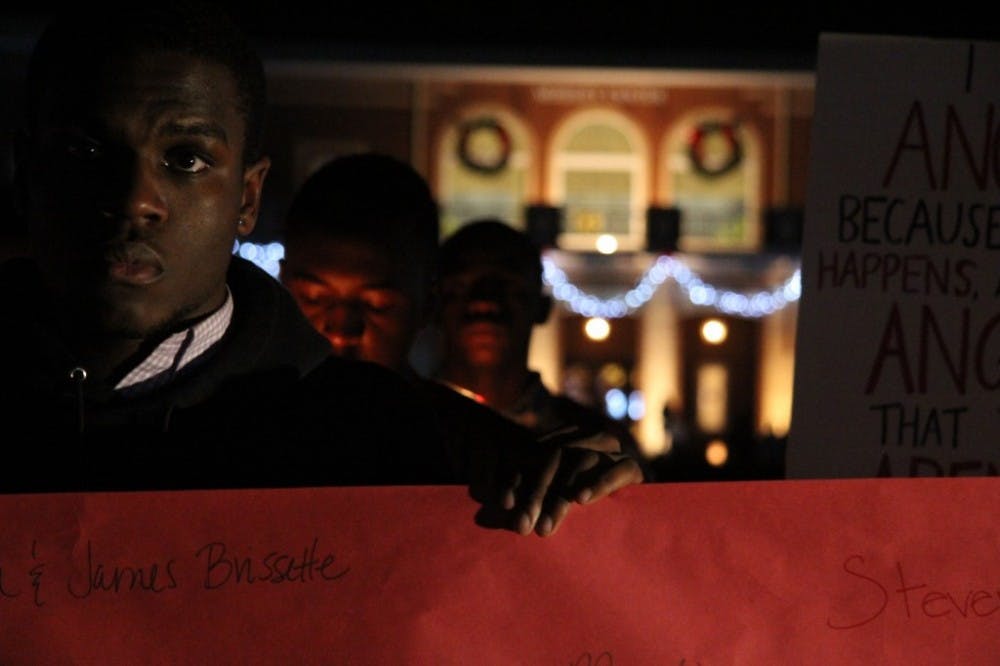
Dozens of demonstrators standing in solidarity with those in Ferguson, Missouri punctuated the holiday cheer of Luminaries at Elon University with the sharp sound of silence Monday evening. Those at the heart of the night’s events said they were brought together in the wake of the lack of an indictment from the police shooting of unarmed black 18-year-old Michael Brown in August.
Organized by a core group of seven activist students and joined by many more — some who jumped in line along the way — the group’s signs spoke for them. Bathed in soft candlelight and bearing pointed phrases such as “black lives matter” and “stand for justice,” the central message unfurled on a large red banner scrawled with a piercing question: “Who’s next?”
Wanting to “disrupt but not interrupt,” the objectors toed a thin line between disturbing a cherished Elon tradition and making the point they believed in, according to junior organizer Jonathan Glover.
“I remember being in Moseley and watching the decision — it was so frustrating and sad for all of us,” Glover said. “We just wanted to let Elon know that this is something we care about, something that won’t go unheard.”
Glover and others said it’s just the beginning of a campus-wide conversation about issues that are larger than Michael Brown — discrimination, racial profiling and police brutality, to name a core few. The red banner that anchored the gathering was covered with names of young black males who have died. Two of the more well-known were Trayvon Martin — who in 2012 was killed by neighborhood watchman George Zimmerman in Florida — and Oscar Grant — who was fatally shot in 2009 by a police officer in Oakland, California.
But that’s not to say all Elon students share the same sort of condemning conviction.
“I don’t fully understand why they’re doing this,” first-year Jake Leavitt said. “If they’re going to protest they should have a call to action and purpose. You shouldn’t just say it was wrong, but they should be addressing issues.”
The purpose of the demonstration was to educate the Elon community about flaws in the judicial system, according to organizer and senior Brenda Reavis. Without understanding, they’ll never be weeded out, she added.
“At the end of the day it’s the system that’s the biggest problem,” Reavis said.
Others were moved by what they described as the raw emotion of the event, one that brought cars to a staggered stop on Haggard Avenue and halted clumps of onlookers in their tracks.
“It was really powerful,” senior Jenna Gilder said. “It was a great moment when the cars had to stop one by one to let each protester cross the street. I’m really glad someone did something.”
Though neither administrators nor campus police interfered with the candle-carrying stream of people who moved across campus, some had feared for the contrary. Word of the demonstration spread entirely by word of mouth and text message — a stark contrast to protesters in Ferguson who have relied heavily on social media to fuel the spread of their message.
Organizers said they chose Luminaries with clear intention as a powerful place to make a statement. The ceremonial lighting draws thousands from Elon and beyond each year. To many students, the silence of the vigil, of sorts, spoke louder than screams.
“Luminaries is the way you will get the most attention,” sophomore Mark McGann said. “The most uncomfortable thing is that some people just walked by. The silence is moving.”
The peaceful nature of the protest proved that there is a way to do it right, said senior organizer D’Netria Spear. She doesn’t condone the sort of violence that has wreaked devastation in Ferguson — smashed police cars and burning buildings — but she does understand how the people there felt they had run out of bloodless options.
“We didn’t have to shout tonight,” Spear said. “We didn’t have to shout to get our point across, to get people to listen.”