

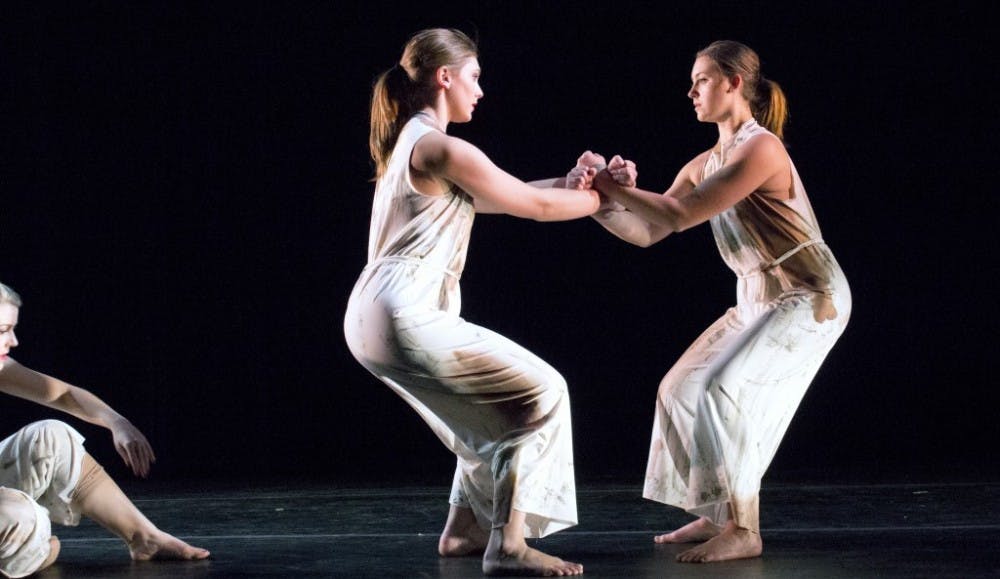
Nine pieces were performed at the Elon University dance program’s fall dance concert, “Dancing in the Black Box” Nov. 6-8. The show included choreography by both students and faculty members as well as a guest artist, Helen Simoneau, who choreographed the final piece, “Flight Distance II.” Each work allowed the audience to grasp a certain emotion that was expressed through the choreography, music and physical appearance of the dancers. The dances also portrayed specific themes, and while some were quite obvious, others had the audiences puzzling over what a specific piece implied.
The show opened with “2.5 Children,” choreographed by senior Sophie McNeill, which depicted women in the 1950s and their conformity to the role of a housewife. The dancers were dressed accordingly, with ’50s-inspired hair and costumes.
Much of the number consisted of slow movement back and forth onstage, rather than a choreographed routine of leaps, kicks and pirouettes. A standout moment from the dance was an eerie yet graceful wave, which irked the character representing the rebellious women of the time period. As the piece’s music faded and the lights dimmed, the dancer ran feverishly in a circle, attempting to push the remaining dancers’ waving hands down.
Artistic Director and Assistant Professor of Dance Jen Guy Metcalf’s piece, “Fragmentations,” emphasized the extraordinary abilities of the dancers’ en pointe. The piece had a darker tone with black costumes and dimmer lights and was full of fast-paced movement and impressive choreography, with each dancer perfectly in sync.
Sophomore Lucas Melfi executed each move with control and showcased his strength and flexibility. It was easily forgotten that this difficult work was being performed en pointe as the trio effortlessly transfixed the audience with their abilities.
The use of upper-body strength was a key component in “From One to Seventeen,” choreographed by senior Kate Phinney. At one moment, a dancer gracefully plunged to the floor into plank position, while another dancer lay over her.
Both moved as one body while the dancer in plank pressed down to the floor. The fluidity of the piece was seen through the dancers gracefully running across the stage in a semicircle. Simultaneously, a mysterious tone was felt, as it seemed like the dancers were running away from something or someone.
What was so intriguing about “Dancing in the Black Box” was the emotional responses from each performance vastly differed from piece to piece, such as feelings of liberation, order, control and confusion. The intensity and drive of each dancer to perform to the best of his or her ability furthered the emotions felt throughout the performances.
A black box theater can often feel restricting, but the fluidity and eloquent movements of the dancers made the space feel infinite. The technical aspects of the performance were also a highlight of the showcase.
The dim lights throughout each piece allowed the audience to really focus on the intricate choreography and the portrayal of emotions, while the carefully orchestrated music correlated beautifully with each dance.
“Dancing in the Black Box” highlighted the incredible talent of Elon’s dance program. Dance can tell stories, express emotions and explore various themes. Each of these components was portrayed in a small, intimate black space filled with adrenaline, strength and remarkable talent.